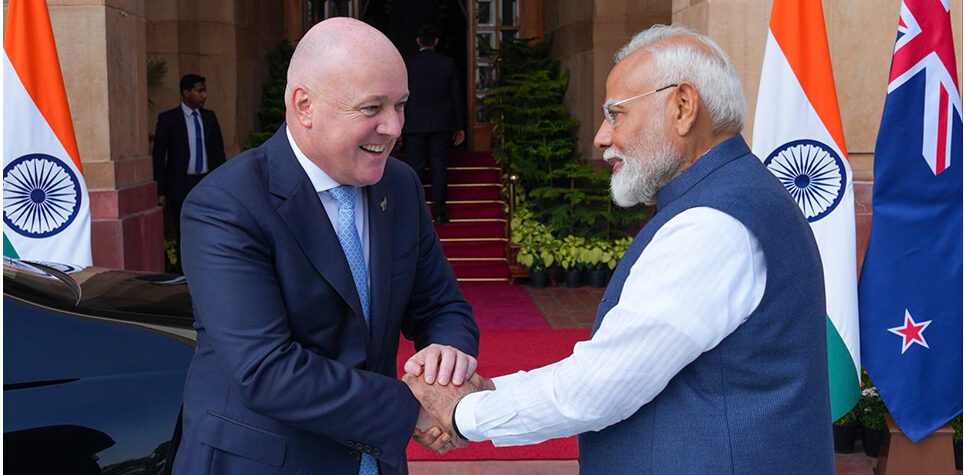
Wellington: The India-New Zealand Free Trade Agreement (FTA) moved closer to implementation on Wednesday after New Zealand’s Parliament approved the legislation with a 93-29 vote, clearing a key domestic requirement for the trade pact to take effect.
New Zealand Prime Minister Christopher Luxon welcomed the parliamentary approval, saying the agreement would expand access to India’s consumer market and contribute to economic growth in New Zealand.
“People told me a Free Trade Agreement with India wasn’t possible. Well, today that deal passed its final vote in Parliament. It’s happening,” Luxon said in a post on X.
He said the agreement would open the Indian market to more New Zealand products and create opportunities for jobs and higher incomes.
The legislation received support from both the ruling National Party and the main opposition Labour Party. India and New Zealand had signed the FTA on April 27, and New Delhi is now looking to bring it into force “as soon as possible”.
Under the pact, New Zealand will provide duty-free access to all Indian exports, covering 100 per cent of tariff lines. The agreement is expected to benefit labour-intensive Indian sectors such as textiles and apparel, leather and footwear, gems and jewellery, engineering goods and processed foods.
New Zealand has also committed to invest USD 20 billion in India over 15 years as part of efforts to deepen long-term economic cooperation.
India, meanwhile, has offered market access on 70.03 per cent of tariff lines covering 95 per cent of bilateral trade. It has excluded 29.97 per cent of tariff lines, including sensitive sectors such as dairy, several agricultural products, sugar and certain metals.
The agreement provides for immediate elimination of duties on 30 per cent of tariff lines, including wood, wool, sheep meat and raw hides, while another 35.60 per cent will see tariffs phased out over three, five, seven or 10 years.
The pact also provides for tariff reductions on products such as wine, pharmaceutical drugs, polymers and certain aluminium, iron and steel products. Tariff-rate quotas will apply to a limited number of products, including Mānuka honey, apples, kiwifruit and albumins.
In services, New Zealand has made commitments across 118 sectors and offered Most-Favoured Nation treatment in 139 sectors. The agreement also provides new mobility opportunities for Indian students and professionals.
Under the Temporary Employment Entry visa pathway, up to 5,000 skilled Indians will be eligible to work in New Zealand for up to three years in specified occupations, while a Working Holiday Visa arrangement will allow 1,000 young Indians annually to stay in the country for up to 12 months.
The agreement also covers student mobility, post-study work opportunities and cooperation in areas including agriculture, investment, research and innovation, technology, renewable energy, digital services, infrastructure and skills.