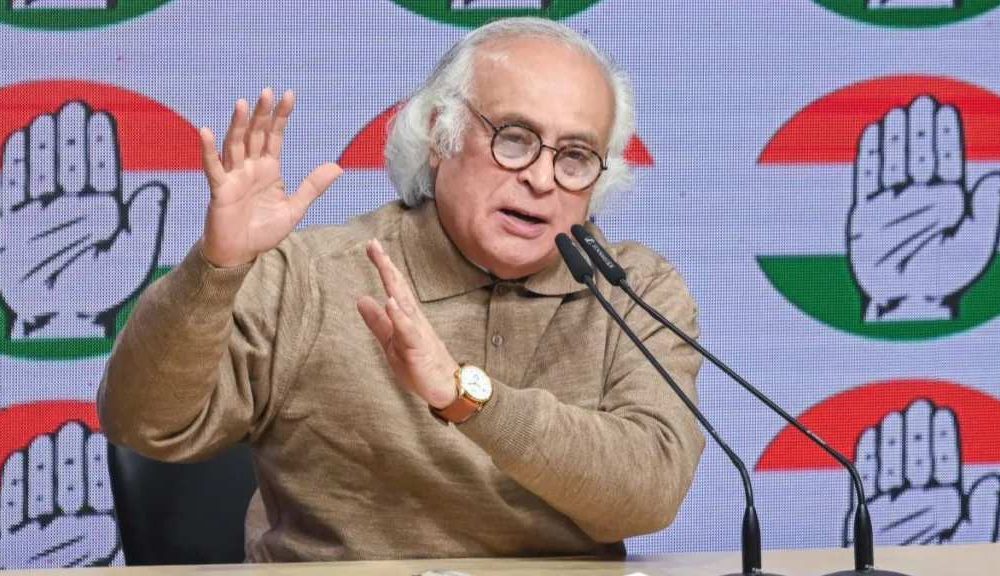
New Delhi: Congress leader Jairam Ramesh on Monday urged the Centre to address PM2.5 pollution across Delhi and North India more seriously, warning that fine particulate matter poses a major public health threat.
“PM 2.5 is choking the nation’s capital and other parts of North India especially,” Ramesh, who served as environment minister in the erstwhile United Progressive Alliance (UPA) government, posted on X.
He said PM2.5 levels in Delhi and North India have remained above the safety standards prescribed by the World Health Organisation (WHO) for quite some time.
“For quite some time it has been abundantly clear that PM2.5 safety standards—that is, for Particulate Matter of size 2.5 micrometres or less in diameter are four times the WHO safety levels (24-hour average) and eight times when taken as an annual average,” Ramesh said.
He added that the National Clean Air Programme (NCAP) “focusses heavily on PM10, but it is the finer particulate matter PM2.5 that is the real killer as far as public health is concerned.”
“The PM2.5 standards need to be revised urgently and enforced strictly,” he stated.
Ramesh concluded, “The PM3.0 government, which is in deep trouble, needs to take this more seriously than it has so far.”
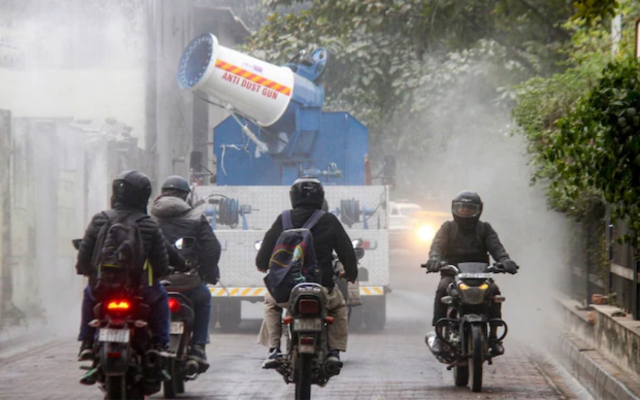
Meanwhile, Delhi continued to face poor air quality on Monday, with the overall Air Quality Index (AQI) hovering between 385 and 428 in the ‘hazardous’ to ‘severe’ range, while several areas recorded very poor pollution levels.
According to the Central Pollution Control Board (CPCB), Akshardham Temple and ITO recorded an AQI of 349 each. India Gate and Janpath stood at 335, while Rohini registered 396, Alipur 375, Vivek Vihar 370 and Narela 363.
Chandni Chowk recorded 358, while Jawaharlal Nehru Stadium registered 343. Burari stood at 308, Aya Nagar at 276 and Indira Gandhi International (IGI) Airport’s Terminal 3 at 263. Anand Vihar recorded an AQI of 242, with these locations falling in the ‘Very Poor’ or ‘Poor’ categories, according to the supplied readings.
Following Dussehra, the Commission for Air Quality Management (CAQM) invoked Stage 1 of the Graded Response Action Plan (GRAP) across Delhi-NCR with immediate effect as air quality deteriorated to the ‘poor’ category.