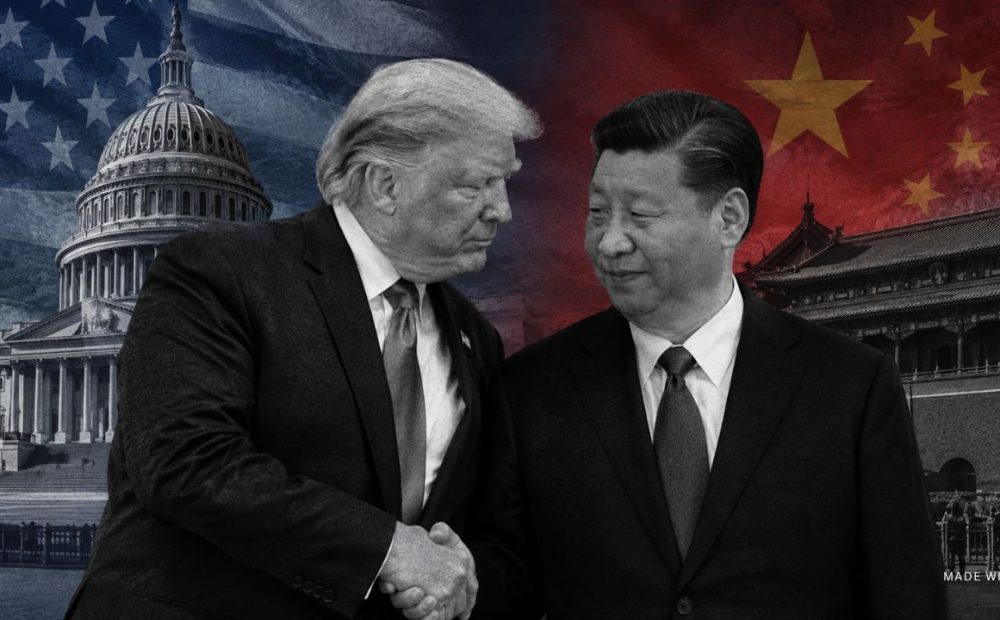
Washington, DC: Chinese President Xi Jinping’s visit to Washington marks one of the most consequential diplomatic engagements of President Donald Trump’s second term, with trade, tariffs, artificial intelligence, critical minerals and global security expected to dominate discussions between the leaders of the world’s two largest economies.
Trump is giving Xi an unusually high-profile welcome, including personally receiving the Chinese president at Joint Base Andrews and hosting him for a state dinner at the White House. The ceremonial welcome underscores the importance Trump attaches to his engagement with Xi, even as the United States and China remain strategic competitors on a range of issues.
Behind the pageantry, however, the talks are expected to be difficult and substantive.
Trump is keen to engage directly with Xi, but Washington remains deeply concerned about China’s economic and strategic influence. Trade and tariffs will be central to the discussions, with the two sides expected to explore possible tariff reductions on some nonessential commodities as a middle-ground solution.
Critical minerals are another important issue. The United States wants greater access to minerals and other materials crucial to advanced manufacturing and technology, while China is likely to seek greater market access for its companies.
The two leaders will also have to navigate the continuing tension over manufacturing.
Trump has made rebuilding American manufacturing a central part of his economic agenda. But China remains a dominant global manufacturing hub, and many U.S. companies continue to rely on Chinese supply chains. That creates an inherent tension between Washington’s push to bring manufacturing back to the United States and the commercial interests of American companies operating globally.
Russia is another potential flashpoint.
The Trump administration has sought greater pressure on countries that continue to purchase Russian oil. China, along with India, remains a major buyer of Russian crude. Any discussion of additional tariffs or penalties linked to Russian energy could therefore become an important part of the Trump-Xi conversation.
Taiwan and the Indo-Pacific will be even more sensitive.
While the United States and China are expected to continue engaging, there is little indication that their fundamental differences over Taiwan or the broader Indo-Pacific competition will disappear. Trump is likely to remain mindful of Chinese concerns while making clear that Washington sees Beijing as a major strategic competitor.
The biggest emerging area of competition, however, may be artificial intelligence.
Trump has increasingly referred to advanced AI as “superintelligence,” reflecting the importance his administration places on winning the technological race. The United States wants to maintain its lead in AI, while China is determined to remain a major player in the development of the technology.
That competition is no longer simply about technology or commercial advantage. AI has implications for economic power, national security and military capabilities, making it an increasingly important component of the broader U.S.-China rivalry.
Trump’s approach to Xi also needs to be viewed through the lens of his broader foreign policy doctrine, which he outlined at the United Nations.
In his UN address, Trump projected the United States as a country willing to combine diplomacy with military strength. He highlighted what he described as his administration’s role in ending conflicts, warned that Iran would not be allowed to acquire nuclear weapons and emphasized the importance of American power in shaping global outcomes.
The speech offered a window into what can be described as the Trumpian approach to foreign policy: engagement backed by power projection.
Trump has repeatedly presented himself as a peacemaker, but his version of peacemaking is closely linked to the belief that American military and economic strength gives Washington leverage at the negotiating table.
That philosophy is particularly relevant to his engagement with Xi.
Trump’s personal approach is to establish direct relationships with powerful leaders and use those relationships to pursue deals. His engagement with Xi reflects that instinct. But China is not simply another negotiating partner. Beijing has its own long-term strategic objectives and remains a formidable competitor to Washington.
That means the optics of the visit should not be confused with a fundamental shift in the U.S.-China relationship.
The United States and China can engage, negotiate and even reach limited agreements while continuing to disagree on major strategic questions.
In fact, that may be the most realistic objective of the visit.
The immediate goal may not be a grand bargain between Washington and Beijing. It may be to manage the relationship — to prevent disagreements over trade, Taiwan, technology, critical minerals and global security from escalating into a larger confrontation.
That is also why the visit has implications far beyond the United States and China.
China’s role in global conflicts, its relationship with Iran, its position on Russia and its influence across the Indo-Pacific all give the Trump-Xi meeting a wider geopolitical significance.
The ceremony will be watched around the world. But the more consequential conversations will take place behind closed doors.
For Trump, engaging Xi does not mean abandoning competition with China. It means attempting to manage that competition from a position of strength.
And for Xi, the challenge will be to engage Washington without compromising China’s core strategic interests.
The outcome may therefore be less about a historic breakthrough and more about whether the two leaders can keep one of the world’s most consequential rivalries within manageable limits.