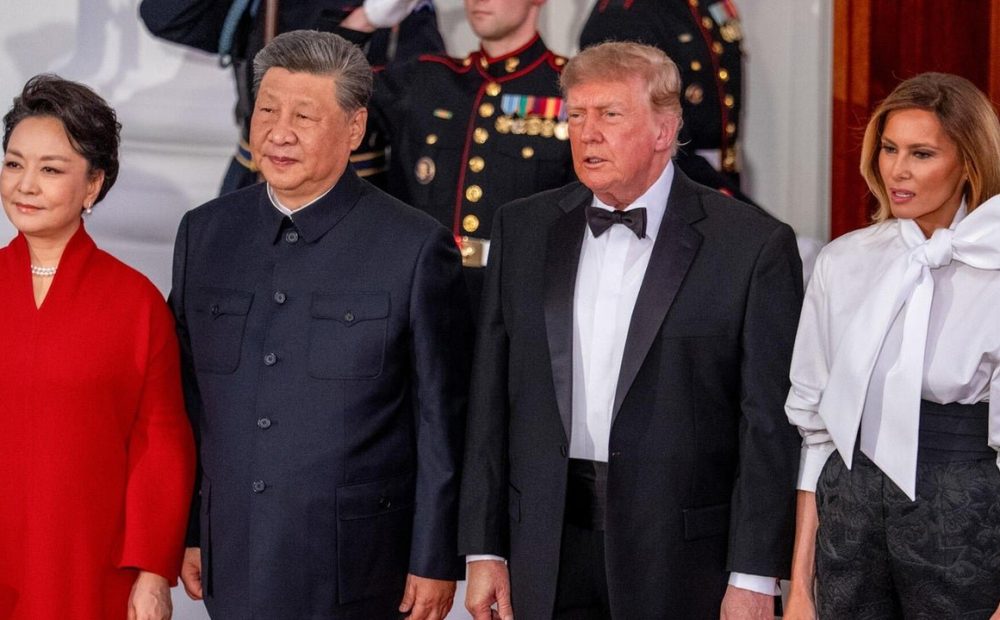
Washington, DC: US President Donald Trump rolled out the red carpet for Chinese President Xi Jinping at the White House, pairing elaborate ceremony and a star-studded state dinner with talks over some of the most consequential disputes between Washington and Beijing.
The three-day visit brought together the leaders of the world’s two largest economies at a moment when trade, artificial intelligence, Taiwan and strategic competition continue to strain US-China relations.
The state dinner underscored the growing importance of technology to the relationship. Tesla CEO Elon Musk, Apple executive chairman Tim Cook, Nvidia CEO Jensen Huang and OpenAI CEO Sam Altman were among the prominent technology and business figures attending.
Trump struck a conciliatory tone during his toast, highlighting his relationship with Xi and the importance of cooperation between the two countries.
Trump-Xi Summit: From Rivalry to Conciliatory Diplomacy | What Changed?
President Donald Trump rolled out the red carpet for Chinese President Xi Jinping, but behind the bonhomie was a clear strategic message.
In his latest analysis, NewsMobile Editor-in-Chief Saurabh Shukla… pic.twitter.com/GDq0lHpi12
— NewsMobile (@NewsMobileIndia) September 24, 2026
Xi, meanwhile, said the ambitions of both countries could reinforce one another, while reiterating the need for Washington and Beijing to manage their rivalry.
But behind the ceremony, major differences remained unresolved.
Trade truce gets another extension
The summit produced an extension of the fragile US-China trade truce, but not a comprehensive settlement.
US Treasury Secretary Scott Bessent said Washington and Beijing agreed to extend the existing arrangement by two months, giving negotiators additional time to work through outstanding economic disputes.
The extension leaves several contentious issues on the table, including tariffs, China’s purchases of US agricultural products, rare-earth shipments and American restrictions on sensitive technologies.
Bessent said China was meeting its commitment to purchase 25 million tons of soybeans but remained behind on a broader pledge to buy $17 billion in other US agricultural products. American officials have also raised concerns over the pace of rare-earth deliveries.
The agreement therefore provides additional breathing room without resolving the underlying trade disputes.
Taiwan remains a major fault line
Taiwan was another key issue in the discussions.
Xi urged Washington to handle the Taiwan issue with caution and reiterated Beijing’s opposition to Taiwanese independence, according to Chinese state media.
The White House did not immediately issue a detailed public account of the exchange.
Washington has long maintained its established position on Taiwan, including opposition to unilateral changes to the status quo, while avoiding an explicit commitment to support Taiwanese independence.
For Beijing, Taiwan remains a core sovereignty issue and one of the most sensitive points in its relationship with Washington.
AI exposes a different US-China divide
Artificial intelligence featured prominently in the summit, with the presence of some of the world’s most powerful technology executives at the state dinner reflecting the economic and strategic importance of the technology.
Trump has argued against imposing additional AI guardrails that could slow US development and has emphasized maintaining America’s technological lead over China.
Xi took a different approach, calling on Washington and Beijing to ensure that AI remains under human control and is developed in a way that serves the public interest.
The contrasting positions highlight a broader question facing both countries: how to compete aggressively in AI while managing the security and societal risks associated with increasingly powerful systems.
Xi warns against a clash between rising and established powers
Xi also revived the concept of the ‘Thucydides trap’, the theory that rivalry between an established power and a rising power can ultimately lead to conflict.
He argued that competition between Washington and Beijing should resemble a race in which both sides seek to advance, rather than a confrontation in which one must defeat the other.
Xi also called for regular military communication and stronger mechanisms to prevent crises from escalating.
Trump, meanwhile, pointed to the countries’ cooperation during World War II as evidence that Washington and Beijing can work together when their interests overlap.
A White House transformed for Xi’s visit
The summit was also an exercise in presidential spectacle.
Trump personally welcomed Xi at Joint Base Andrews before the Chinese leader was given a formal arrival ceremony at the White House. The program featured military demonstrations, an elaborate review and a flyover involving US military aircraft.
The White House was also redesigned for the occasion, with the Rose Garden and South Lawn transformed for the ceremonies.
The state dinner featured American ingredients with Chinese influences and began with a toast using Schramsberg sparkling wine, echoing the historic 1972 toast between President Richard Nixon and Chinese Premier Zhou Enlai.
The visual pageantry stood in sharp contrast to the unresolved disputes that continue to define the relationship.
Trump appeared eager to emphasize the personal rapport between the two leaders. Asked about the substance of his discussions with Xi, he largely brushed aside questions and instead praised the Chinese president and the meeting.
The summit therefore delivered a carefully managed display of cooperation while leaving the biggest structural disagreements between Washington and Beijing — from trade and technology to Taiwan and military tensions — largely in place.