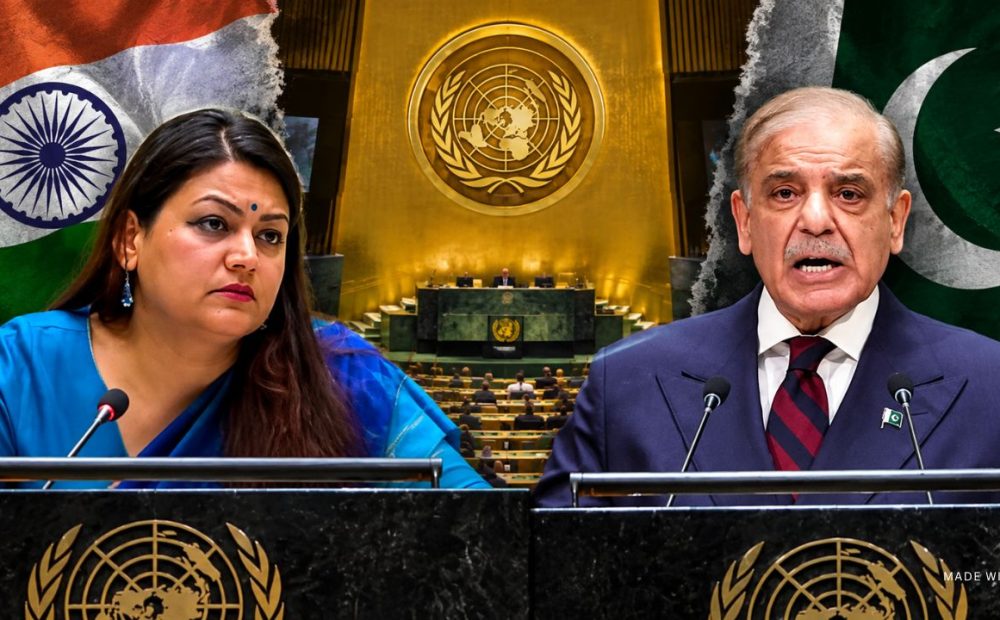
New York: India on Saturday hit back at Pakistan Prime Minister Shehbaz Sharif’s remarks at the United Nations General Assembly, rejecting Islamabad’s claims on Kashmir and the 2025 India-Pakistan conflict while warning that continued cross-border terrorism would have consequences.
Exercising India’s right of reply at the UN in New York, First Secretary Petal Gahlot described Sharif’s remarks as “bizarre” and questioned Pakistan’s record on terrorism, human rights and religious minorities.
Gahlot also invoked the Sept. 11, 2001, attacks in the United States, pointing out that al-Qaida leader Osama bin Laden, the mastermind of the attacks, was found living in Abbottabad, Pakistan, near the country’s premier military academy.
“The US just observed the anniversary of the 9/11 attacks. Its mastermind was living at the doorsteps of Pakistan’s Army’s premier academy,” Gahlot said.
Her remarks came a day after Sharif used his UNGA address to revisit the 2025 military confrontation with India, crediting US President Donald Trump with “timely intervention” that he said helped prevent a wider conflict. Sharif also again raised Kashmir, arguing that a “just and fair solution” to the dispute was necessary to prevent South Asia from returning to the brink of conflict.
India has consistently rejected Trump’s claims that he personally brokered an end to the 2025 fighting, maintaining that the cessation of hostilities followed direct communication between the two countries’ military officials and did not involve third-party mediation.
‘Terrorism will have consequences’
In her response, Gahlot warned Islamabad that India would continue to exercise its right to defend itself against terrorism.
“We demonstrated last year that terrorists will have nowhere to run and nowhere to hide. Our right to defend ourselves against terrorism will be exercised. And continued terrorism by Pakistan will have consequences,” she said.
India launched Operation Sindoor on May 7, 2025, striking what New Delhi described as terror infrastructure in Pakistan and Pakistan-occupied Kashmir. The operation followed the April 22 Pahalgam attack in Jammu and Kashmir that killed 26 civilians.
Gahlot accused Pakistan of presenting itself as a defender of security while allegedly supporting terrorism, saying the international community should judge Islamabad by its actions rather than its diplomatic statements.
“Reiterating falsehood year after year will not make it true. Pakistan’s duplicity and deceit will neither benefit it nor the world,” she said.
India rejects Kashmir claims
Sharif devoted part of his roughly 23-minute UNGA address to Kashmir, arguing that resolving the dispute was essential to preventing another major India-Pakistan confrontation.
India rejected the remarks, reiterating that Jammu and Kashmir is an integral part of the country.
Gahlot also turned the focus toward Pakistan-occupied Kashmir, citing alleged human rights violations there.
“Let’s turn focus to PoK. Ask the people of Rawalkot about the wanton killings and human rights violations by the Pakistan government there,” she said.
She also challenged Pakistan’s references to democracy and human rights, accusing the country’s military establishment of retaining decisive political influence.
India raises minorities, blasphemy laws
Gahlot further questioned Sharif’s remarks on religious tolerance, pointing to Pakistan’s blasphemy laws and treatment of religious minorities.
“The Pakistani regime has blasphemy laws as its mainstay. The world knows how Pakistan treats its minorities,” she said.
The Indian representative also accused Islamabad of using the UN platform to deliver what she called “hypocritical homilies” on democratic values while failing to address its own domestic record.
Indus Waters Treaty dispute
The two countries’ long-running dispute over the Indus Waters Treaty also featured in Sharif’s UNGA address.
India placed the treaty in abeyance following the Pahalgam attack, saying cooperation under the agreement could not continue while Pakistan supported cross-border terrorism. Pakistan has rejected India’s position and has maintained that the treaty remains legally binding.
Sharif also warned that any attempt to divert Indus waters would be treated by Pakistan as an act of war, adding another contentious issue to his address.
India’s latest response at the UN underscores the widening diplomatic divide between New Delhi and Islamabad, with terrorism, Kashmir and water sharing continuing to dominate their exchanges at international forums.