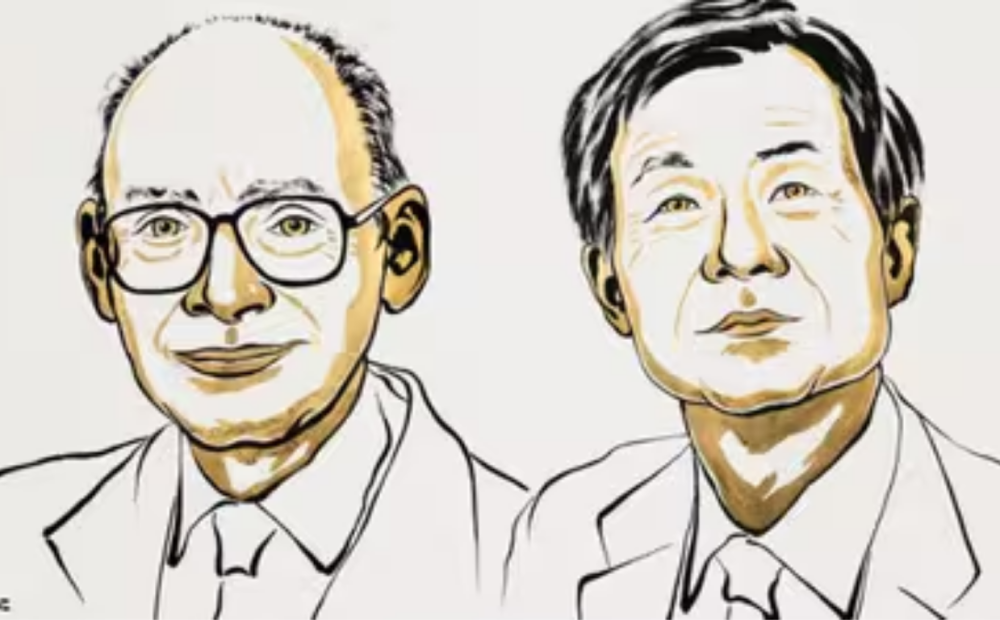
French scientist Henri B. Kagan and Japanese scientist Kenso Soai won the 2026 Nobel Prize in Chemistry on Wednesday for discovering non-linear effects and autocatalysis in asymmetric organic synthesis.
The Royal Swedish Academy of Sciences said their work helped explain how homochirality, the tendency of molecules in living systems to favor one of two mirror-image forms, can emerge spontaneously.
Solving A Century-Old Chemical Mystery
Kagan made a breakthrough in 1986 by developing a method to produce a greater excess of one molecular mirror image than previously possible.
Soai advanced the research in 1995 by designing a reaction capable of producing one mirror-image form, and demonstrated such a reaction in 2003.
Their discoveries have been important for chemists developing pharmaceutical manufacturing processes because different molecular forms can have different effects in the body.
Nobel Committee for Chemistry chair Heiner Linke said the scientists had provided a solution to a chemical mystery more than a century old, calling their reactions “spectacular.”
Kagan, born in France, is affiliated with Université Paris-Sud in Orsay, while Soai, 95, was born in Japan and is affiliated with the Tokyo University of Science. The influential “Soai reaction” is named after Soai’s experiments.
The Nobel prize comes with 12 million Swedish kronor, about $1.2 million. This year’s Nobel awards began with medicine on Monday and physics on Tuesday. The literature prize will be announced Thursday, followed by the peace prize Friday and economics on Monday.