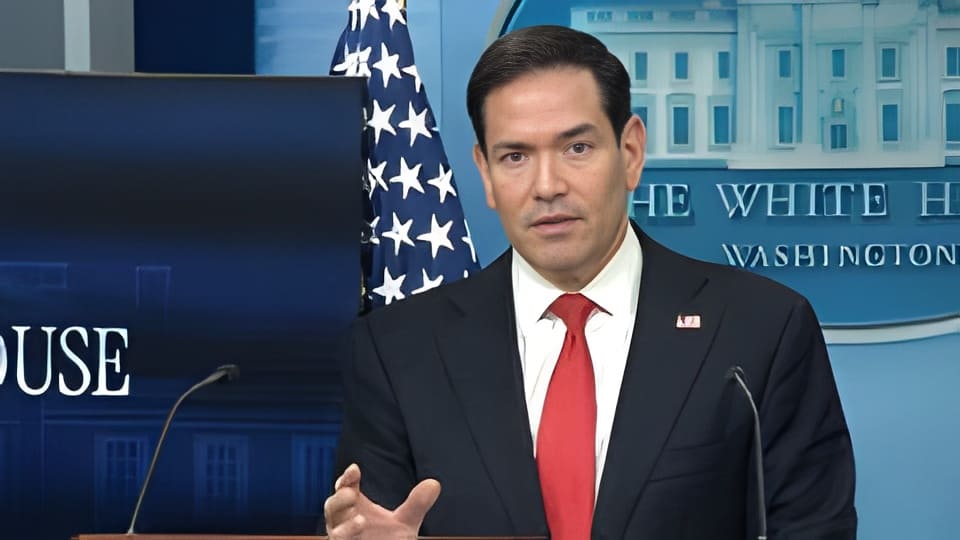
Athens (Greece): United States Secretary of State Marco Rubio has asserted that Iran will be permanently barred from obtaining nuclear weapons under President Donald Trump, while accusing Tehran of amassing an extensive stockpile of ballistic missiles and unmanned aerial systems designed to protect its nuclear programme from foreign military intervention.
Addressing a joint media briefing alongside Greek Foreign Minister Giorgos Gerapetritis in Athens, Rubio stressed that Washington’s stance remains unyielding despite ongoing speculation over whether the United States might tolerate restricted uranium enrichment by Tehran under a prospective accord.
“Iran cannot have a nuclear weapon, simple, period and end of story,” Rubio said.
While withholding specific parameters concerning acceptable thresholds of nuclear activity during potential diplomatic negotiations, the Secretary reiterated that preventing Iran from acquiring nuclear weapons remains the administration’s primary directive.
“Anything they agree to that would be acceptable to the United States has to be something that ensures that Iran will never have a nuclear weapon,” he said.
Rubio made these declarations in response to a question regarding recent statements by Vice President JD Vance, who emphasised that Tehran must demonstrate tangible commitments regarding its enrichment capabilities.
The top American diplomat contended that Tehran deliberately pursued conventional military supremacy to create a deterrent shield protecting its nuclear sites from external air strikes.
According to Rubio, the Iranian strategy relied on stockpiling vast quantities of missiles and drones capable of inflicting catastrophic retaliation upon any nation attempting to halt its nuclear ambitions.
He maintained that the Trump administration aggressively intervened to dismantle this tactical deterrent.
“He destroyed their drone programme, their drone manufacturing capability,” Rubio said, referring to Trump.
“He destroyed their missile capability. He severely eroded both of those capabilities in terms of current launchers. He destroyed their navy. He destroyed their air force.”
These claims concerning the scale of the damage inflicted on Iranian military assets were not independently substantiated during the press briefing.
Nevertheless, Rubio insisted that Iran’s strategic posture has been severely weakened, stripping Tehran of its conventional capability to shield its nuclear installations from punitive action.
“They will never have a nuclear weapon, period, not as long as President Trump is in office,” he said.
Furthermore, the Secretary of State delivered a scathing assessment of the Iranian domestic economy, attributing the nation’s worsening fiscal crisis entirely to the misrule of its governing elite.
He observed that punishing international sanctions continue to exert crushing financial pressure on Tehran, forecasting an even steeper economic decline.
“Their economy is in total and complete freefall,” Rubio said.
The Secretary denounced the regime for spending national wealth on regional proxy groups rather than directing funds towards domestic development and public welfare.
Specifically, Rubio identified Hezbollah, Hamas, the Houthis and militias operating from Iraq as beneficiaries of Iranian financial support.
In addition to regional security matters, he reported that the Strait of Hormuz remains fully operational, noting that petroleum transit volumes through the critical maritime bottleneck have nearly rebounded to pre-conflict levels.
“There’s almost as much oil flowing out now as there was before this conflict began,” he said.
Rubio’s wide-ranging statements were delivered during discussions with Greece that also covered maritime security, energy supplies and the consequences of instability in the Middle East.