Washington, DC: Elon Musk has escalated his public criticism of India’s satellite internet approval process, taking aim at billionaire Mukesh Ambani and questioning why his Starlink service has yet to receive clearance to operate in the country.
In a post on X on Friday, the Tesla and SpaceX CEO sarcastically addressed Prime Minister Narendra Modi as “Prime Minister Ambani,” accusing the Reliance Industries chairman of wielding influence over India’s policy decisions.
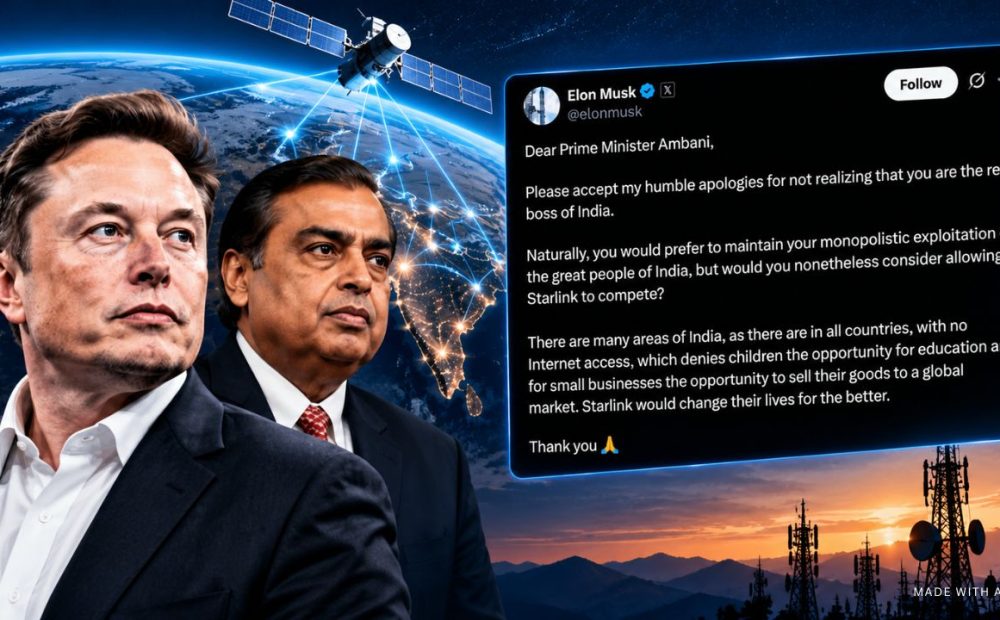
“Dear Prime Minister Ambani, please accept my humble apologies for not realising that you are the real boss of India,” Musk wrote.
Dear Prime Minister Ambani,
Please accept my humble apologies for not realizing that you are the real boss of India.
Naturally, you would prefer to maintain your monopolistic exploitation of the great people of India, but would you nonetheless consider allowing Starlink to compete?
There are many areas of India, as there are in all countries, with no Internet access, which denies children the opportunity for education and for small businesses the opportunity to sell their goods to a global market. Starlink would change their lives for the better.
Thank you 🙏
— Elon Musk (@elonmusk) October 9, 2026
He also urged Ambani to allow Starlink to compete in the Indian market, alleging that established players were seeking to protect their dominance.
Musk argued that satellite internet could help bridge connectivity gaps in remote parts of India, providing children with access to education and enabling small businesses to reach international markets.
He further claimed that Starlink had helped save lives during natural disasters when conventional communication networks failed, adding that its services could benefit communities across India.
The latest remarks follow a series of posts in which Musk has accused unnamed business interests of obstructing Starlink’s entry into the country.
On Wednesday, Musk alleged that “certain oligarchs” were preventing the company from operating in India to preserve their market dominance. He described the alleged obstruction as a “crime against the people of India.”
Unfortunately, we are being blocked by certain oligarchs in order to maintain their monopolistic chokehold on the Indian people. You can guess who they are …
This is a crime against the people of India!
— Elon Musk (@elonmusk) October 7, 2026
The Ministry of Communications rejected the allegations on Thursday, maintaining that India’s regulatory framework for satellite communication services was fair and non-discriminatory.
“A post is being circulated on social media regarding the fairness of India’s regulatory framework for satellite communication services and suggesting that it is being applied in a discriminatory manner,” the ministry said.
It added that the government had established an authorisation framework applicable to all telecommunications services, including satellite-based connectivity.
Musk subsequently questioned the delay in Starlink’s approval, claiming the company had spent five years meeting India’s legal and regulatory requirements.
“Starlink is licensed in over 165 countries and has spent five years complying with every single law and requirement of the government of India, so why still no license?” he wrote on Thursday.
Regulatory clearances remain pending
Starlink, owned by SpaceX, is among three companies that have received telecom licences from the Indian government to provide satellite-based communication services. The other two are Eutelsat OneWeb, backed by Bharti Enterprises, and Jio Satellite Communications Ltd., a wholly owned subsidiary of Jio Platforms.
However, obtaining a telecom licence does not automatically permit a company to begin commercial operations. The providers must also meet the government’s security requirements and receive spectrum assignments before launching their services.
The government has said security assessments for satellite communication services are underway.
The dispute comes as satellite internet providers seek to expand their presence in India, a market with significant demand for connectivity in remote and underserved regions. While conventional broadband and mobile networks serve much of the population, satellite-based services are positioned to reach areas where extending terrestrial infrastructure can be difficult.
Musk’s latest comments have brought the regulatory process into the public spotlight, with the Starlink chief pressing for permission to compete against established Indian telecom operators.
The government, however, has maintained that its authorisation framework applies equally to satellite communication providers, rejecting suggestions that the process is discriminatory.