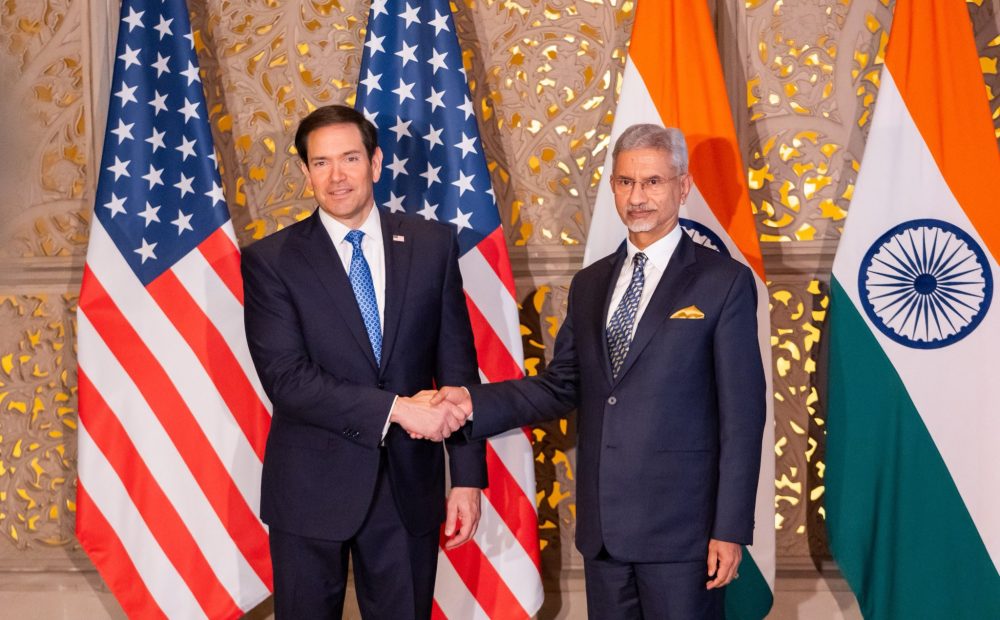
Mumbai: US Secretary of State Marco Rubio on Wednesday dismissed the term “UN experts” as an “oxymoron” while responding to questions about the United Nations’ criticism of India’s handling of protests, saying Washington would not interfere in the country’s domestic political affairs.
Speaking during his two-day visit to India, Rubio said protests and political disagreements were part of democratic life, while stressing that decisions on internal political matters rested with the Indian people.
Asked about opposition parties and students protesting in India and allegations by UN experts of a crackdown on demonstrators, Rubio declined to comment directly on the dispute.
“Well, the UN experts, yeah. My favourite. The UN experts, or is that an oxymoron?” he remarked.
Clarifying Washington’s position, Rubio said India was a democracy where political differences were addressed through elections and public debate.
“I mean, I am not going to get involved in their politics. This is a democracy. They have elections here. So I am not going to align on their domestic political matters,” he said.
Rubio described freedom of expression and the ability to participate in political debate as important features of democratic societies. He also distinguished peaceful demonstrations from violent unrest involving vandalism, arson and destruction of property.
Citing Cuba as an example, he pointed to restrictions faced by opposition voices there, including the threat of imprisonment, repression or exile.
“But we’re not going to comment on internal political matters. That’s for the Indian people to decide and navigate,” Rubio said.
India Pushes Back Against UN Experts
Rubio’s remarks came a day after India challenged allegations by UN experts concerning the handling of protests, maintaining that human rights should not be used as a tool for political pressure or selective targeting of countries.
Addressing the UN General Assembly on Tuesday, Indian diplomat Barkha Tamrakar defended the country’s constitutional framework, citing safeguards under Article 21, which protects the right to life and personal liberty and provides a foundation for due process.
Her response followed concerns raised by UN experts over the alleged excessive use of force against protesters, restrictions on peaceful assembly and claims of enforced disappearances.
“India firmly opposes any attempt to convert unverified allegations, incomplete statistics, or a report that contains no India country observation into a negative characterization of the world’s largest democracy,” Tamrakar said.
She reiterated that human rights discussions should be guided by impartiality and evidence rather than political considerations.
India has also questioned what it sees as inconsistencies in the international response to protests in different countries, arguing that allegations against New Delhi should not be treated as established facts without India-specific evidence.
Rubio Says US Ties With Pakistan Won’t Come at India’s Expense
Separately, Rubio sought to reassure New Delhi over Washington’s expanding engagement with Pakistan, saying the United States’ relationship with Islamabad would not undermine its partnership with India.
In an interview with The Indian Express, Rubio rejected comparisons between President Donald Trump’s approach to South Asia and the US policy pursued during President Richard Nixon’s administration in the 1970s, when Washington maintained close ties with Pakistan’s military government under Gen. Yahya Khan.
“I would not use the 1970s as an example because the world looks nothing like it did back then. Back then, we had the Cold War and all sorts of other dynamics that no longer exist,” Rubio said.
Addressing concerns over the Trump administration’s engagement with Pakistan, including its outreach to Pakistani Army chief Asim Munir, Rubio said Washington did not view its relationships with the two South Asian neighbours as competing interests.
“Our relationship with no country in the world, in any way, comes at the expense of our relationship with India. We don’t view it that way in our relationship with India,” he said.
Rubio pointed to his visit to India, ongoing efforts to negotiate a trade agreement and broader bilateral engagement as evidence of Washington’s commitment to the partnership.
He also argued that maintaining ties with Pakistan could provide Washington with an opportunity to discourage actions that might heighten tensions with India.
“Pakistan is a country we have a relationship with, and we need to have a relationship with. And, in some ways, it could be a positive thing if we could help discourage actions that could potentially lead to conflict, if we could use our influence in ways that are positive,” he said.
Rubio Acknowledges Challenges in Ending Ukraine War
Rubio also acknowledged the difficulties involved in securing an end to Russia’s war in Ukraine, which has continued for four years.
Describing the conflict as complex, he said a resolution would not be easy to achieve.
“These things are complex, and if this was an easy war to solve, it would have been solved a long time ago,” Rubio said.
His comments came during a two-day visit to India that included discussions on bilateral relations, trade and broader geopolitical developments.