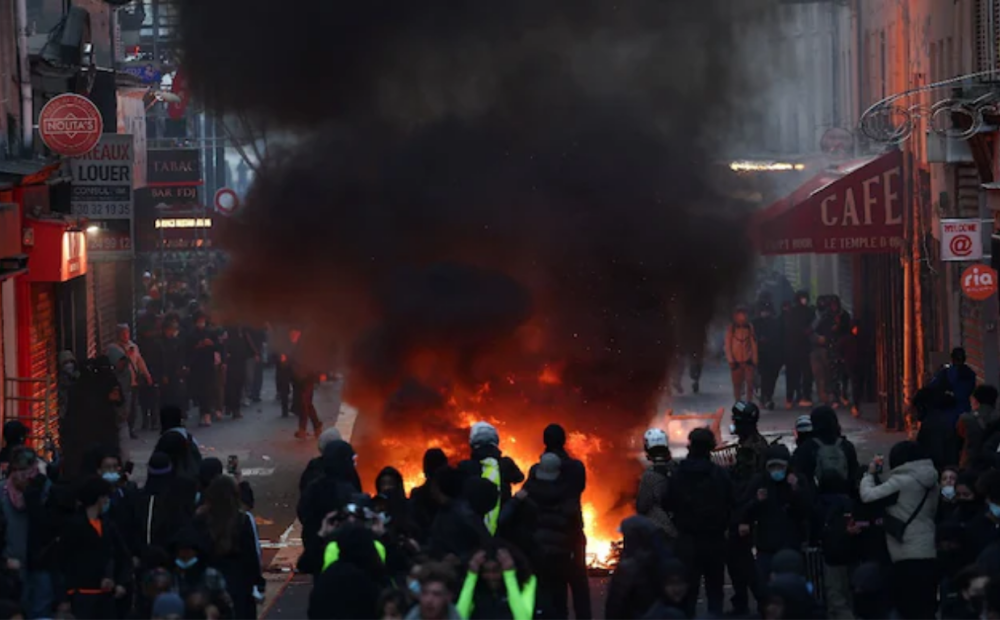
Paris: More than four lakh people took to the streets across France on Saturday to protest rising living costs, economic inequality and deteriorating public services, as police fired tear gas and deployed water cannons during clashes in several cities.
Protests over the rising cost of living have spread across France, with demonstrators clashing with riot police in Paris as public discontent grows over economic pressures
#France #Paris #Protests #CostOfLiving #WorldNews #Europe #BreakingNews https://t.co/7ZDSRJ286S
— NewsMobile (@NewsMobileIndia) October 25, 2026
The French Interior Ministry estimated nationwide participation at around 4.1 lakh, while trade unions put the figure at nearly 8 lakh, according to the reports.
In Paris, police estimated that 1.1 lakh people joined the march, which remained largely peaceful until clashes broke out towards the end.
Violence was also reported in Lyon, Marseille, Bordeaux, Lille and Nantes. In Marseille, protesters blocked a street with metal sheets, set rubbish bins on fire and threw stones and bottles at riot police.
Authorities deployed 70,000 police officers and gendarmes nationwide, 10,000 more than the previous weekend. Interior Minister Laurent Nunez said 135 people had been arrested by early afternoon.
Police also recovered fireworks, metal balls and other objects that could be used as weapons.
In Paris, several major museums, including the Louvre and Musée d’Orsay, closed, while more than 20 metro stations were shut as a precaution.
The demonstration was relocated from Bastille to Porte d’Italie, prompting criticism from unions over restrictions on the right to protest.
The movement began last month with student demonstrations over school conditions before expanding into wider protests over economic pressures and public services.
Left-wing leader Jean-Luc Mélenchon joined the Paris march and called for the government to address social discontent.
Meanwhile, the Yellow Vests movement announced plans for further demonstrations on October 31.
The movement originated in 2018 over fuel prices and living costs before broadening its opposition to economic inequality and President Emmanuel Macron’s policies.