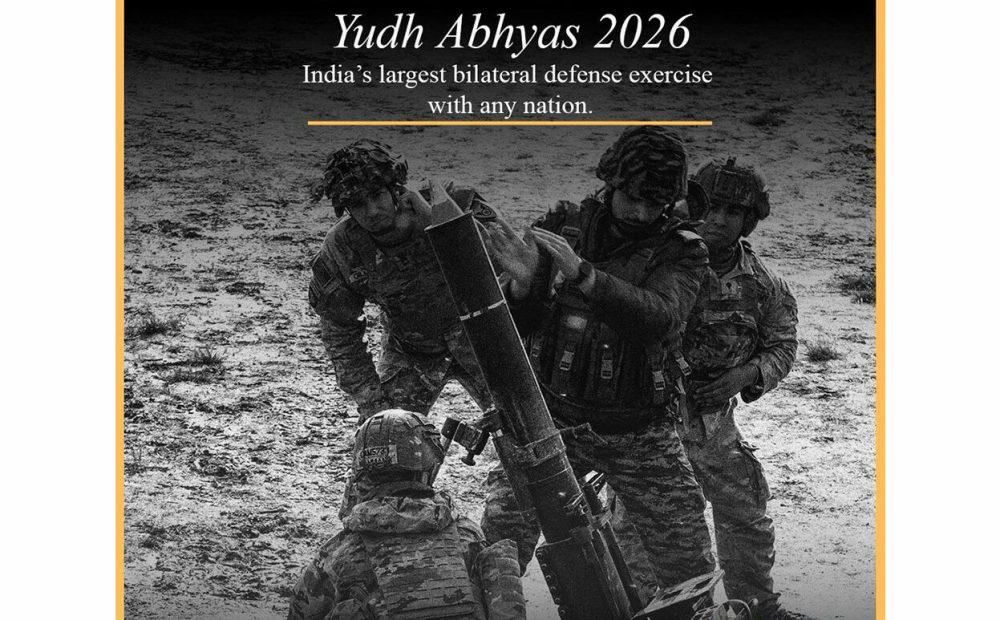
New Delhi: The 22nd edition of the annual Army exercise between India and the United States, Yudh Abhyas, will be held soon, the US Embassy in India announced on Tuesday.
The announcement comes as the United States and India continue to deepen their defence alignment through Yudh Abhyas, a flagship bilateral military exercise sponsored by US Army Pacific.
The US Embassy, in a post on X, highlighted the role of the joint exercise in reinforcing the US-India Major Defense Partnership.
Since 2004, Yudh Abhyas, a U.S. Army Pacific-sponsored bilateral exercise with the Indian Army, has enhanced combined interoperability and strengthened the U.S.-India Major Defense Partnership in support of a free and open Indo-Pacific. pic.twitter.com/mz6AH5Akwp
— U.S. Embassy India (@USAndIndia) September 1, 2026
“Since 2004, Yudh Abhyas, a U.S. Army Pacific-sponsored bilateral exercise with the Indian Army, has enhanced combined interoperability and strengthened the U.S.-India Major Defense Partnership in support of a free and open Indo-Pacific,” the post read.
Last year, the 21st edition of Exercise Yudh Abhyas involved 450 personnel led by a battalion of the Madras Regiment, training alongside US soldiers from the 1st Battalion, 5th Infantry Regiment (“Bobcats”). It became one of the largest bilateral military exercises for the Indian Army in terms of troops mobilised, a press release said.
The 21st edition commenced on September 1 at Fort Wainwright, Alaska, and continued through September 14, according to an official statement by the Embassy of India in Washington.
The Indian Army contingent, comprising 450 personnel led by a battalion of the Madras Regiment, arrived in Fairbanks on August 31. They trained alongside US soldiers from the 1st Battalion, 5th Infantry Regiment (“Bobcats”), part of the 1st Infantry Brigade Combat Team (Arctic Wolves), 11th Airborne Division.
The 2025 edition focused on five areas: mountain and high-altitude operations under sub-arctic conditions; heliborne and air-mobility integration, backed by artillery and aviation assets; electronic warfare, surveillance, and counter-drone systems; medical evacuation and combat casualty care in field conditions; and live-fire tactical drills to validate seamless interoperability.
Since its inception in 2002 as a platoon-level exercise, Yudh Abhyas has expanded in scope and participation. Past editions have covered diverse terrains, including high-altitude warfare in India’s Auli and Chaubattia, desert manoeuvres in Rajasthan, and urban and cold-environment training at Joint Base Lewis-McChord and Alaska.
Yudh Abhyas has become a flagship, high-complexity Army-to-Army exercise and one of the cornerstones of India-US military cooperation. India conducts more military exercises with the US than with any other country.
These exercises, including Yudh Abhyas, Malabar, COPE India, Vajra Prahar, Tiger Triumph and several others, are central to building interoperability and forging mutual trust. They demonstrate how the two democracies continue to work towards peace, security and prosperity, including in the Indo-Pacific region.