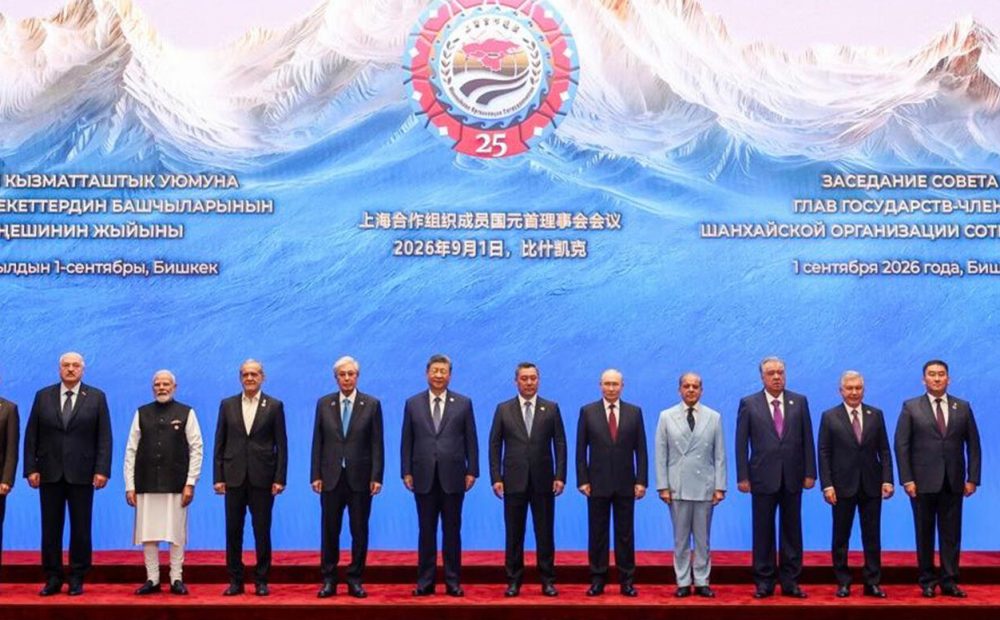
Bishkek: Prime Minister Narendra Modi on Tuesday signed the Bishkek Declaration at the 26th Shanghai Cooperation Organisation (SCO) Summit along with heads of state of other member countries.
The heads of state signed the Bishkek Declaration on the 25th Anniversary of the Shanghai Cooperation Organisation, according to a statement by the organising committee.
The SCO Summit was held from August 31 to September 1, 2026, in Bishkek, Kyrgyzstan. The summit was chaired by Kyrgyz President Sadyr Japarov under the theme “25 Years of the SCO: Together for Sustainable Peace, Development and Prosperity.”
Along with the declaration, SCO leaders signed 27 other documents, including regulations on the Universal Center for Countering Challenges and Threats to the Security of SCO Member States and an action plan for developing ports and logistics centres of member countries for 2026-2030.
The leaders also signed a declaration on strengthening multilateral partnership for nuclear and physical nuclear security, a statement on developing cooperation in energy systems and a cooperation programme for establishing the SCO “Green Technology Corridor” for 2026-2030.
The Bishkek Declaration provides India a platform to articulate its positions on regional security, development and connectivity and strengthens India’s engagement with Central Asia and the wider Eurasian region.
The Ministry of External Affairs detailed several key outcomes from the discussions at the Bishkek summit.
The approval of regulations on the Universal Centre for Countering Challenges and Threats to the Security of SCO Member States strengthens cooperation with SCO partners on terrorism, extremism, organised crime and other transnational threats. It also enhances coordination and information exchange on transnational security threats.
The Protocol on Amendments and Additions to the Charter of the Shanghai Cooperation Organisation of June 7, 2002, enables India to participate in shaping the SCO’s evolving institutional framework. It also ensures India’s interests are appropriately reflected in the organisation’s future functioning and supports the inclusion of English within the SCO framework, MEA spokesperson Randhir Jaiswal said in a post on X.
A memorandum was also signed between the authorised agencies of SCO Member States on cooperation in the field of information. This promotes institutional exchanges among member states and facilitates possible wider dissemination of India’s perspectives and initiatives within the SCO information space.
A memorandum between the Governments of SCO Member States on cooperation in combating climate change provides an additional platform for cooperation on climate adaptation and mitigation. It supports climate-resilient development and technology cooperation and enables capacity-building while reflecting India’s development priorities.
A protocol on amendments and additions to the agreement on cooperation between the Governments of SCO Member States in combating crime of June 11, 2010, strengthens India’s cooperation with SCO partners against organised and cross-border crime and facilitates closer coordination among law-enforcement agencies.
A statement on providing assistance to states affected by emergencies complements India’s capabilities in disaster management and HADR. It enables sharing of expertise and capacity-building and promotes cooperation on disaster-resilient infrastructure.
A statement on the Development of Cooperation in the Field of Energy Systems promotes cooperation in the development, modernisation and resilience of energy systems among member states and advances India’s energy efficiency and security objectives.
The leaders also signed a statement on developing cooperation in energy conservation and energy efficiency. It supports India’s energy-efficiency and energy-security objectives and provides scope for exchanging technologies, experience and best practices.
The SCO Member States also adopted a programme on Coordination of Measures to Combat the Proliferation of Synthetic Drugs and their Precursors for the period up to 2030. The programme addresses the challenge of synthetic drugs and precursor diversion and improves information-sharing and operational coordination among enforcement agencies.
The leaders signed a programme of Cooperation among SCO Member States in Combating Drug Addiction until 2030. According to the MEA, it complements India’s drug-demand reduction efforts, enables the exchange of good practices in prevention, treatment and rehabilitation, and promotes cooperation on drug awareness and addiction prevention.
Earlier on Tuesday, PM Narendra Modi, in his address at the SCO Summit, reiterated India’s position that dialogue and diplomacy are the only way forward to resolve conflicts. He stressed the need for zero tolerance towards terrorism and also emphasised that there should be no double standards in the fight against terrorism.
The Prime Minister highlighted the importance of connectivity, technology, innovation, startups and youth engagement. He also announced India’s readiness to host the first SCO Civilisation Dialogue Forum.