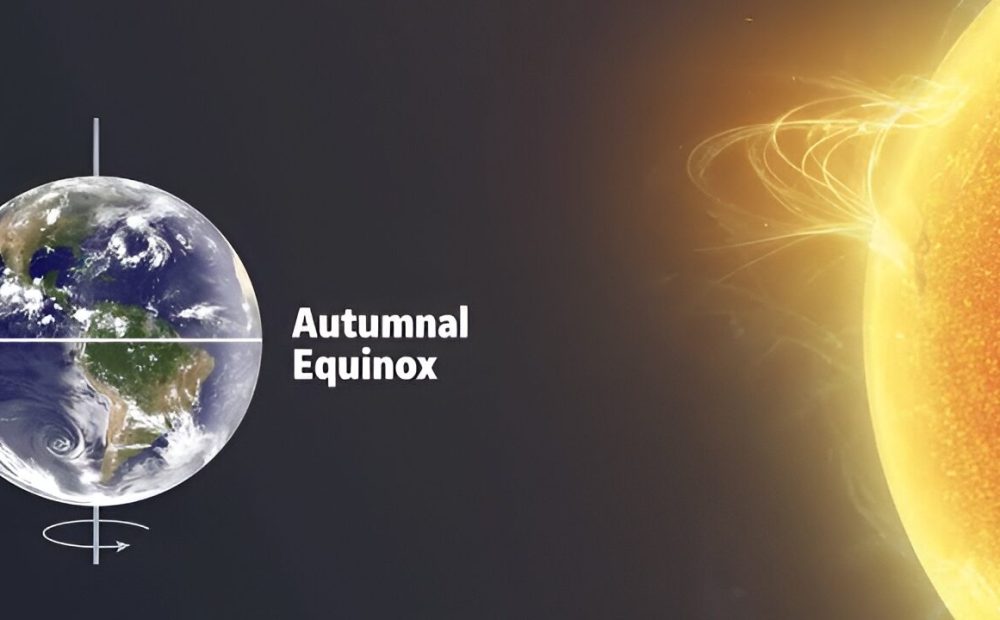
New Delhi: The September Equinox falls today, September 23, 2026, marking the moment when the Sun crosses the equator as it appears to move southward from the Northern Hemisphere to the Southern Hemisphere.
During an equinox, Earth’s axis and its position in orbit allow the Sun to illuminate the Northern and Southern Hemispheres almost equally. Equinoxes occur twice a year, marking the transition between seasons.

Why Is It Known As Equinox?
The term “equinox” comes from the Latin words meaning “equal night.” During an equinox, neither hemisphere is tilted toward or away from the Sun, resulting in nearly equal amounts of daylight and darkness across the globe.
However, equinox days do not actually consist of exactly 12 hours of daylight and 12 hours of darkness everywhere. Atmospheric refraction and the apparent size of the Sun mean that daylight generally lasts slightly longer than 12 hours.
Equinox And Its Connection With Seasons
An equinox occurs twice a year — in March and September. The March equinox is known as the spring or vernal equinox in the Northern Hemisphere, while the September equinox is known as the autumnal equinox.
During the March equinox, the Sun appears to cross the equator from the Southern Hemisphere toward the Northern Hemisphere. During the September equinox, it crosses from the Northern Hemisphere toward the Southern Hemisphere.
The equinoxes mark the beginning of astronomical spring and autumn in the Northern Hemisphere, while the seasons are reversed in the Southern Hemisphere.
Festivals Celebrated During September Equinox

Various cultural traditions and festivals are associated with the September Equinox and the autumn harvest season.
One of the best-known celebrations is Chuseok, a major Korean harvest festival observed over several days in South Korea and North Korea.
The Mid-Autumn Festival, also known as the Moon Festival, is another major celebration associated with the autumn season. It is observed by Chinese and Vietnamese communities around the world and is traditionally linked to the full moon closest to the autumnal equinox.
In the United States and Canada, Thanksgiving is also associated with the autumn harvest season, although it is not celebrated specifically on the September Equinox.
Why Does The Date Change Every Year?

The date of the equinox changes because a calendar year does not precisely correspond to the length of the tropical year — the period used to measure the cycle of the seasons.
The Gregorian calendar has 365 days in a common year and 366 days in a leap year. In comparison, the tropical year lasts approximately 365.2422 days.
This difference means that, without adjustments, the equinoxes and solstices would gradually shift to later times and dates in the calendar.
A leap day is added to the calendar approximately every four years to help keep the calendar year synchronised with the Earth’s seasonal cycle. However, the adjustment is not exact, which is why the timing of equinoxes and solstices can still vary from year to year.
Other factors, including variations in Earth’s orbital motion, its rotation and the gradual change in the orientation of Earth’s rotational axis, also influence the precise timing of equinoxes and solstices.