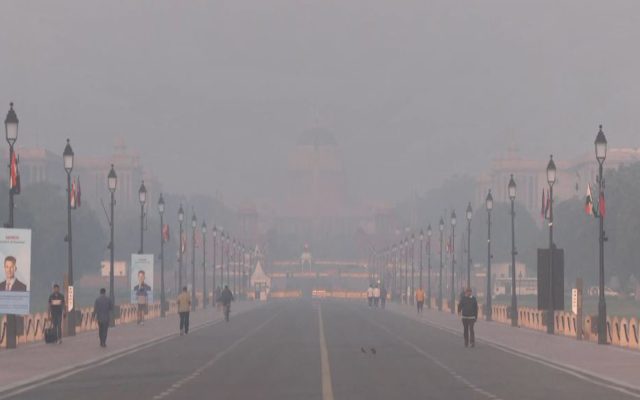
Mumbai: A layer of smog engulfed Mumbai’s Bandra Kurla Complex (BKC) on Saturday morning, reducing visibility across the area despite ongoing efforts by the Brihanmumbai Municipal Corporation (BMC) to tackle air pollution.
As of October 22, Mumbai recorded 231 days with ‘Good’ or ‘Satisfactory’ Air Quality Index (AQI) levels, compared with 218 days in 2025, 216 in 2024 and 185 in 2023.
Data from the Union Environment Ministry’s PRANA portal showed that the city’s PM10 concentration declined by approximately 48 per cent between 2017-18 and 2025-26.
The BMC has issued 28-point pollution-control guidelines for construction sites and deployed 76 ward-level squads, each required to inspect at least two sites daily.
Violations can lead to show-cause notices, stop-work orders or site sealing. Air-quality sensors are mandatory, with 3,166 construction sites connected to a central monitoring dashboard.
To reduce road dust, the civic body uses 29 multipurpose vehicles for deep cleaning and sweeping.
Construction and demolition waste vehicles must remain covered, with wheels washed before entering public roads. Waste movement and disposal are tracked through the Mumbai Debris Control and Tracking System (MDCTS).
The BMC said bakeries contribute around 3.5 per cent of Mumbai’s particulate emissions. Of 593 bakeries, 209 used cleaner fuels, 175 had converted, 69 were transitioning, 87 remained non-compliant and eight had closed.
The civic body is installing pollution-control devices at 10 crematoria and monitoring open-burning hotspots. Its Winter Air Pollution Mitigation and Enforcement Action Plan 2026 covers construction compliance, road dust, open burning and vehicle checks.
Public campaigns also highlight firecracker-related air and noise pollution, with firecrackers prohibited on public streets, footpaths and in silence zones.