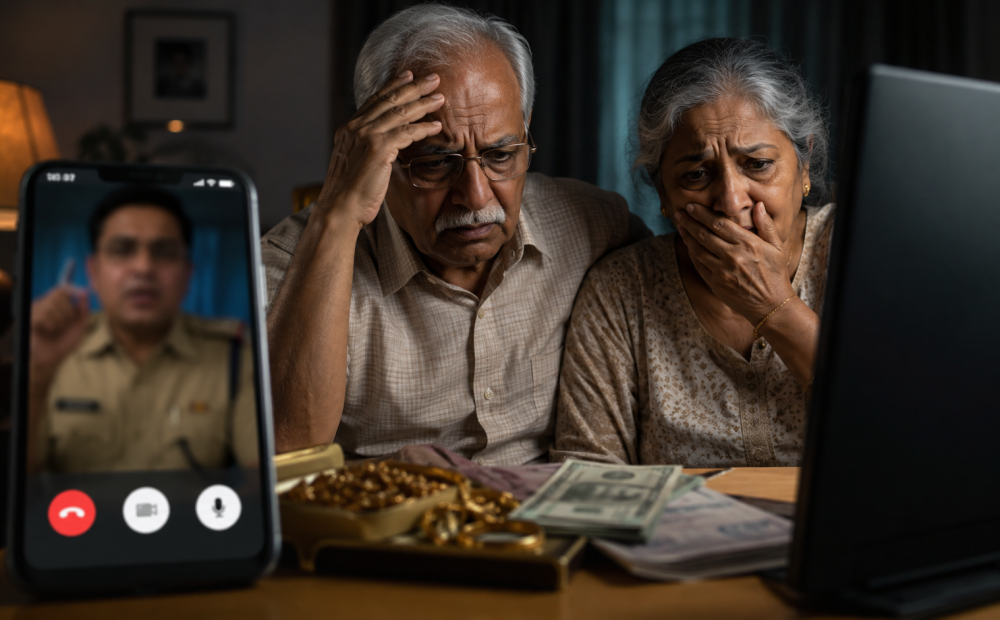
An elderly couple in Bhopal was allegedly kept under “digital arrest” for 96 days by fraudsters posing as Delhi Police officers, an investigation official and a Supreme Court judge. The accused threatened the couple with arrest and property seizure in a fake money-laundering case before forcing them to transfer ₹22 lakh.
Suvarna Lakshmi and Narasimha Rao, residents of Kolar in Bhopal, are originally from Palnadu district in Andhra Pradesh. The ordeal began on May 19, when Suvarna received a call from a man who introduced himself as Khanna from Delhi’s Daryaganj police station.
He claimed that arrest warrants had been issued against the couple and alleged that their names were linked to crores of rupees in transactions through a Canara Bank account in Delhi. The fraudsters also falsely connected them to a money-laundering case involving businessman Naresh Goyal.
The couple was then put through repeated video calls, where the callers allegedly questioned them and ordered them not to leave their home or speak to anyone. On May 21, a woman claiming to be a Chief Investigation Officer obtained details of their bank accounts.
A day later, the fraudsters introduced another person as a judge. During the video call, he allegedly showed the couple details from their Aadhaar cards and threatened legal action. On June 9, the fake judge reportedly told them that their property would be seized.
The fraudsters then instructed the couple to arrange money to settle the alleged case. They were told to use their fixed deposits and jewellery. After returning to Bhopal from Andhra Pradesh, the couple pledged their jewellery on June 12 and raised ₹22 lakh.
The money was transferred in five instalments to bank accounts supplied by the accused. However, even after receiving the full amount, the fraudsters allegedly continued threatening and monitoring the couple.
They stayed in contact through seven WhatsApp numbers and kept the couple under video surveillance until August 23. Suspicion finally arose when the couple independently checked the documents shared with them and discovered that the supposed Supreme Court order was fake.
The couple then approached the cyber cell and filed a complaint. Police registered an FIR on August 27 and transferred the case diary to Kolar police station.
Investigators are now examining the seven WhatsApp numbers, video calls and the five bank accounts used to receive the ₹22 lakh.
The case shows how digital-arrest frauds exploit fear. Scammers impersonate police officers, judges or other officials, accuse victims of serious crimes and isolate them through video calls before demanding money. No genuine police or court process requires a person to remain on a video call for days or pay money to avoid arrest.