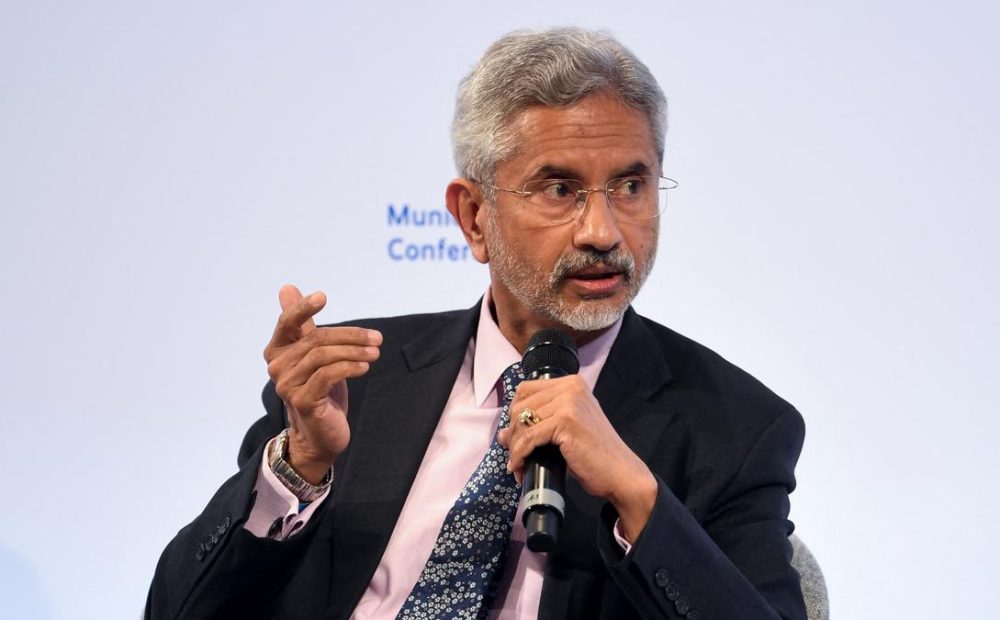
New Delhi: External Affairs Minister S Jaishankar on Tuesday said peace and tranquillity in the border areas are essential for normalising India-China relations, stressing that any disturbance along the border would have consequences.
Speaking in a conversation with John Micklethwait, Editor-in-Chief of the Bloomberg New Economy Forum, in Delhi, Jaishankar said India and China do not have an agreed border and that the issue has persisted for decades.
“We don’t have an agreed border between India and China. This is not a new issue; it’s been going on for multiple decades… From 1975 till 2020, a good 45 years, no blood was shed on that border. The last time there were fatalities was in 1975. In this period, India-China relations did grow,” he said.
Jaishankar said the situation changed in 2020, when a series of border issues culminated in a clash that resulted in the deaths of soldiers on both sides.
“Then in 2020, when we were in the midst of the COVID lockdown, we had a series of border issues, and it culminated in a clash in which a number of soldiers were killed on either side,” he said.
“For us, what it represented was a very profound departure from the situation that was prevailing since 1975. If the peace and tranquillity in the border areas are disturbed, then the relationship will have consequences. Those consequences were very visible for the next five years until we were able to restore the peace and tranquillity. It took four years of negotiations,” he added.
Emphasising India’s position on normalising ties with China, Jaishankar said the boundary situation must remain stable for broader bilateral relations to progress.
“The point we make to the Chinese is: ‘If you want a normal relationship, if the rest of the relationship is to move, it’s common sense. It’s a no-brainer that the boundary has to be stable, that we need peace and tranquillity in the border areas.’ As the border areas are settling down, they have settled down to a great extent since 2024; the relationship is commensurately moving towards normalcy,” he said.
Asked whether India would consider allowing greater Chinese investment if an early harvest agreement were reached, Jaishankar said discussions on the possibilities were ongoing. However, he clarified that investment and market access policies would be addressed separately from the boundary issue.
“It’s an active conversation. We are now looking at those possibilities, and we have to see where we go. But we are not insisting that you have to solve the boundary issue in order to do business. What we are saying is: the bar is lower. The bar is: please maintain peace and tranquillity. I wouldn’t link the early harvest to anything other than the boundary question resolution. Anything we do on any policy we have on business, market access issues, etc., on investment, will be dealt with separately,” Jaishankar said.
He also highlighted major economic challenges in India’s trade and business relations with China, pointing to the imbalance in bilateral trade and difficulties faced by Indian businesses in accessing the Chinese market.
“This is not just an issue of the boundary. We also have very major economic issues with China. If you look today at the trade balance, it is completely tilted… the tilt is extremely one-sided, and in many sectors where we’ve done well with the rest of the world, we have not had market access; we’ve not had a successful business operation for that sector in China,” he said.
“So we do believe today that we’re not getting a level playing field in China in the manner in which we have given a level playing field to them,” Jaishankar added.
Earlier in September, Jaishankar said India-China bilateral ties were “better” than in preceding years, noting that the relationship was returning to normalcy as outstanding border issues were progressively resolved.
Speaking during a conversation hosted by the Asia Society in New York, Jaishankar discussed the recent trajectory of India-China relations, which have improved following Chinese President Xi Jinping’s recent visit to India for the BRICS Leaders’ Summit in New Delhi.
Reflecting on the timeline of diplomatic recovery, Jaishankar said, “If you asked me, compared to where you were in 2025, is the relationship better today? I would say yes. Compared to 2024, even more so.”
Follow the NewsMobile WhatsApp Community to get all the latest updates from around the world, directly on your WhatsApp