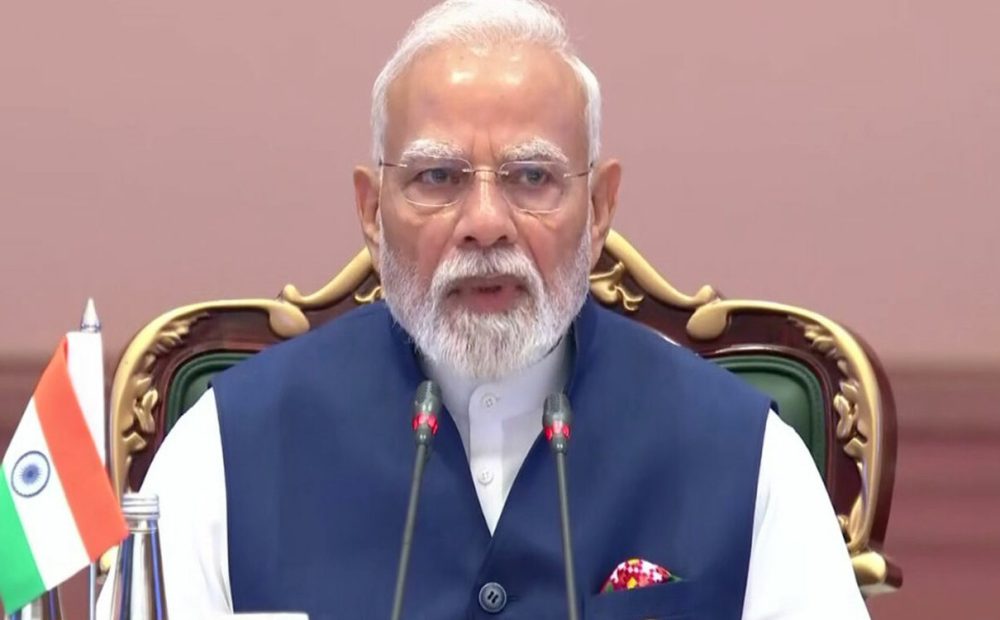
New Delhi: Prime Minister Narendra Modi arrived at Bharat Mandapam on Sunday for Day 2 of the 18th BRICS Summit in New Delhi.
Prime Minister Narendra Modi arrives at Bharat Mandapam on Day 2 of the BRICS Summit 2026 #BRICS2026 #MODI #PMmodi #BRICSSummit #BharatMandapam #NewDelhi @narendramodi pic.twitter.com/OFudjSfscb
— NewsMobile (@NewsMobileIndia) September 13, 2026
PM Modi welcomed world leaders at the venue before joining them for the BRICS family photograph. He stood at the centre, with Russian President Vladimir Putin and Chinese President Xi Jinping beside him.
PM Modi Joins World Leaders For BRICS Day 2 Family Photo#BRICS2026 #BRICSSummit #PMModi #NarendraModi #India #NewDelhi #BharatMandapam #WorldLeaders #GlobalSouth #Diplomacy #GlobalGovernance #InternationalRelations #Geopolitics #WorldNews #BreakingNews pic.twitter.com/zD2SugXXF0
— NewsMobile (@NewsMobileIndia) September 13, 2026
The second day features an open session on “Resilience, Innovation, Cooperation and Sustainability: Shaping the Future for Inclusive Global Growth”.
Modi Unveils BRICS Push On Startups, AI & Digital Agriculture#BRICS2026 #BRICSSummit #PMModi #NarendraModi #AI #DigitalAgriculture #Startups #Technology #SupplyChains #CriticalMinerals #Innovation #GlobalSouth #India #NewDelhi #WorldNews pic.twitter.com/gQrzSJ1CHP
— NewsMobile (@NewsMobileIndia) September 13, 2026
PM Modi is also scheduled to hold bilateral meetings with leaders from South Africa, Egypt, Kazakhstan, the Philippines, Burundi, Uganda and Nigeria.
Earlier, BRICS leaders unanimously adopted the New Delhi Declaration, which PM Modi described as reflecting a BRICS that is “wider in reach and stronger in purpose”.
PM Modi Highlights BRICS Trust, Resilience, Innovation And Cooperation At Summit
Prime Minister Narendra Modi on Sunday noted that the “trust of Global South nations in BRICS has grown,” while highlighting key initiatives on disaster management, MSME cooperation, technology, critical minerals and the environment by the 11-nation group.
Chairing the BRICS session on ‘Resilience, Innovation, Cooperation and Sustainability: Shaping the Future for Inclusive Global Growth’ on the second day of the 18th BRICS Summit, PM Modi said that “India has advanced the spirit of friendship, partnership, and cooperation through the BRICS platform.”
“We have endeavoured to ensure that BRICS cooperation is not limited to governments alone; we want our entrepreneurs, farmers, researchers, women, youth, and ordinary citizens to become active participants as well,” he said.
He added, “I can say from personal experience that the trust of Global South nations in BRICS has grown, because their voices are heard, their experiences are respected, and solutions are crafted not just for them, but with them. The strength of BRICS lies in our diversity and cooperation. We may be rooted in different realities, but together we rise through cooperation and blossom for humanity. May our diversity remain our identity, our cooperation serve as our inspiration, and our progress benefit all of humanity.”
The Prime Minister noted that BRICS nations reached a consensus on the BRICS Integrated Early Warning System for the prevention of and response to infectious diseases.
He said, “Today, the number of tensions in the world is constantly rising, having a significant and widespread negative impact on the lives of ordinary people. Pandemics, climate disasters, and supply chain disruptions have demonstrated that in today’s interconnected world, no crisis remains confined to a single region. Therefore, we have placed special emphasis on enhancing resilience within the BRICS group. It is equally essential to identify challenges in a timely manner, remain prepared for them, and take immediate action. With this approach, a consensus has been reached on a BRICS Integrated Early Warning System for the prevention of and response to infectious diseases. Additionally, Early Warning Data Integration Guidelines have been formulated for disaster management.”
In the New Delhi Declaration, the 11 nations welcomed the establishment of a dedicated Sub-Working Group to advance the BRICS Integrated Early Warning System for the prevention and response to Mass Infectious Diseases.
PM Modi also emphasised BRICS CONNECT (BRICS Cooperation Network for Capacity Building, Employability, and New Skills and Technologies), under which BRICS nations have promoted skills, employability and women’s participation in the workforce.
“Through ‘BRICS Connect,’ we have promoted skills, employability, women’s participation in the workforce, social security, and capacity building. An initiative for a BRICS MSME cooperation portal has been launched to link small enterprises with knowledge, finance, and new markets. A BRICS Urban Mobility Hub has been established to facilitate the sharing of best practices among our cities,” he said.
Invoking the Indian civilizational connection to nature, PM Modi said that within BRICS, emphasis has been placed on balancing human development and the environment.
“In Indian civilisation, nature is revered as a mother. For centuries, we have held the belief that development and the environment are not alternatives to each other, but are complementary. Within BRICS, too, we have emphasised the balance between human development and the environment; this forms the foundation of sustainability and represents our obligation towards future generations.”
“We have made progress on several fronts in this regard. We have set up a BRICS Digital Centre of Excellence for smart grids and energy storage, which will help make our clean energy systems more reliable, efficient, and accessible. Centres of Excellence for agroecology and regenerative agriculture will integrate traditional knowledge with modern science. Furthermore, principles formulated for community-based climate adaptation will establish indigenous knowledge as a vital foundation for climate action,” the Prime Minister added.
Addressing the open session, PM Modi also said that weaponization of technology and critical minerals could hinder shared progress among BRICS countries and called for inclusivity in the adoption of technology.
The Prime Minister said the BRICS Logistic Supply Chain Cooperation Framework will “help make our supply chains more reliable and resilient”.
“Under the umbrella of innovation, the BRICS Incubator Network will connect our startups and incubators. We have proposed the BRICS Startup Innovation Fund to promote innovative and scalable solutions. The BRICS Network on Digital Agriculture will create new opportunities for farmers; through this initiative, AI, geospatial technology, and digital public infrastructure will be aligned with the actual needs of farmers. The weaponization of technology and critical minerals could hinder our shared progress; therefore, we have emphasized inclusivity in the adoption of technology,” PM Modi said.
The Prime Minister again said that the trust of Global South nations in BRICS has grown, because their voices are heard, their experiences are respected, and solutions are crafted not just for them, but with them.
“The strength of BRICS lies in our diversity and cooperation. We may be rooted in different realities, but together we rise through cooperation and blossom for humanity. May our diversity remain our identity, our cooperation serve as our inspiration, and our progress benefit all of humanity,” he said.
BRICS leaders on Saturday unanimously adopted the New Delhi Declaration, which stressed the importance of building reliable and resilient supply chains for critical minerals.
“We affirm the need to promote reliable, responsible, diversified, resilient, fair, sustainable, and just supply chains of critical minerals to guarantee benefit sharing, value addition and economic diversification in resource-rich countries,” the Declaration said.
It also emphasised the need to preserve the sovereign rights of resource-rich countries over their mineral resources, including “their right to adopt, maintain and enforce measures necessary to pursue legitimate public policy objectives.”
The Declaration recognised “the key role of critical minerals for the development of zero- and low-emission energy technologies, energy security, and resilience of energy supply chains.”
PM Modi described the Declaration outcome as a reflection of a BRICS that is “wider in reach and stronger in purpose”.
The last leg of the summit chaired by India is focused on the core pillars of resilience, innovation, cooperation and sustainability. The two-day summit is being hosted by India on September 12-13 under the chairship theme, “Building for Resilience, Innovation, Cooperation and Sustainability.”
WHO Chief Tedros Thanks PM Modi At BRICS Summit
WHO Director-General Tedros Adhanom Ghebreyesus thanked Prime Minister Narendra Modi after meeting him on the sidelines of the BRICS Summit in New Delhi. Tedros praised BRICS leaders for their support to the WHO and their commitment to universal health coverage and stronger health systems.