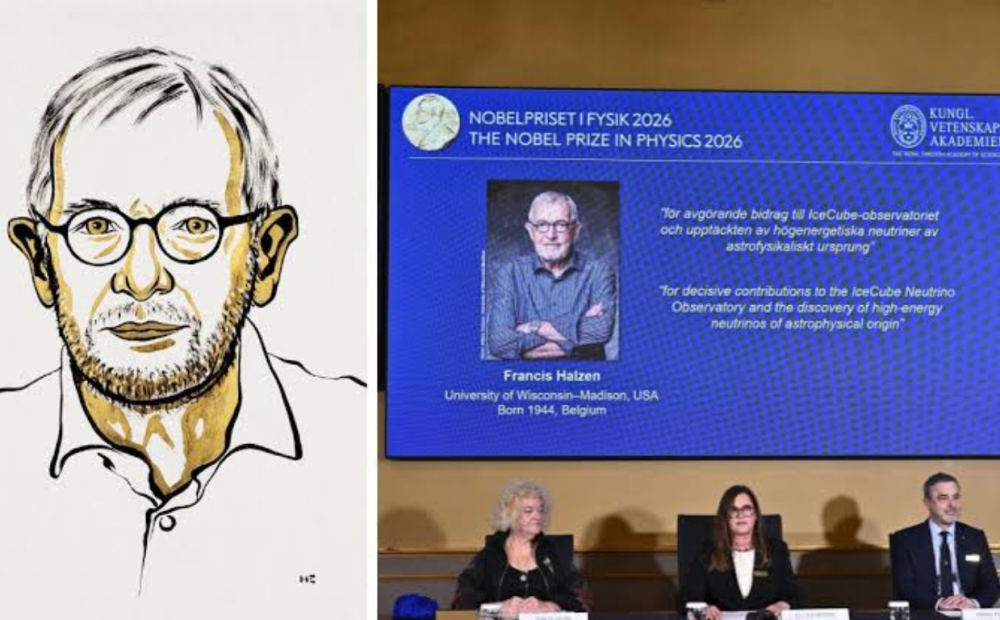
Belgian-American particle physicist Francis Halzen has won the 2026 Nobel Prize in Physics for his decisive contributions to the IceCube Neutrino Observatory and the discovery of high-energy neutrinos of astrophysical origin.
The Royal Swedish Academy of Sciences recognised his work in developing an observatory capable of detecting some of the universe’s most elusive particles, often called “ghost particles” because they rarely interact with matter.
BREAKING NEWS
The Royal Swedish Academy of Sciences has decided to award the 2026 #NobelPrize in Physics to Francis Halzen “for decisive contributions to the IceCube Neutrino Observatory and the discovery of high-energy neutrinos of astrophysical origin.” https://t.co/UcPBWk0RiK— The Nobel Prize (@NobelPrize) October 6, 2026
IceCube And The “Ghost Particles”
Halzen realised that Antarctic ice could be used to track neutrinos. The IceCube Observatory, covering a cubic kilometre of ice and equipped with light sensors, detects neutrinos from extremely energetic processes in distant space.
Researchers say these “messengers from the cosmos” could reveal how exploding stars and other violent cosmic events produce high-energy neutrinos, potentially uncovering unknown phenomena.
Who Is Francis Halzen?
Halzen is a Belgian-American particle physicist who has led an international team of researchers and engineers behind IceCube.
In 2014, Smithsonian magazine dubbed him “Neutrino Man” and honoured his pioneering work with an Ingenuity Award, calling the experiment the beginning of a new era in astronomy.
His scientific vision and leadership made IceCube a landmark instrument for neutrino astronomy.
Nobel Prize And Ceremony
The physics prize carries 12 million Swedish crowns ($1.2 million), shared if multiple winners are named.
Nobel medals will be presented by Sweden’s King Carl XVI Gustaf in Stockholm on December 10, followed by the traditional banquet. This is the second 2026 Nobel announced after the medicine prize, with chemistry next.