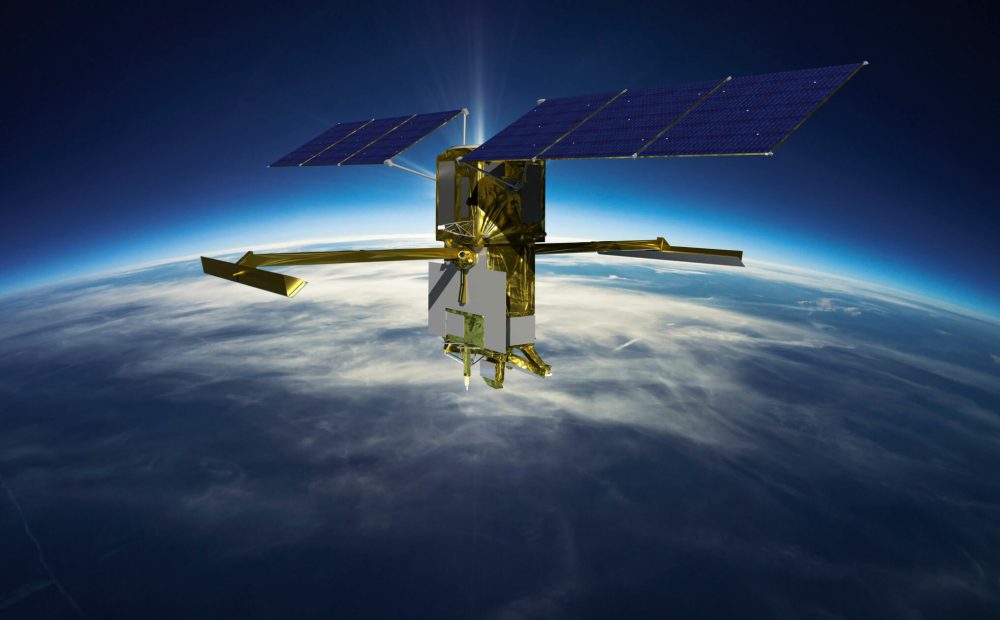
New Delhi: India and France are preparing to launch TRISHNA from Sriharikota in 2027, a joint satellite mission aimed at studying Earth’s water resources as climate change intensifies droughts, disrupts rainfall and accelerates glacier retreat.
TRISHNA, meaning “thirst” in Sanskrit, stands for Thermal infraRed Imaging Satellite for High-resolution Natural resource Assessment. Built by ISRO and French space agency CNES, it will provide resolution better than 60 metres, with revisits several times a week.
Operating from a Sun-synchronous orbit more than 700 kilometres above Earth, the satellite will use thermal infrared observations to monitor surface temperatures, vegetation stress, water availability, evapotranspiration and other aspects of the water cycle. CNES is supplying the thermal infrared instrument, while ISRO is developing the optical payload.
The data will support agriculture, water management, coastal monitoring, glaciers, forests, urban heat islands and ecosystem health. TRISHNA aims to bridge a gap in existing space-based systems, which generally offer either high detail with infrequent observations or frequent observations at coarser resolution.
The mission builds on the Indo-French Megha-Tropiques satellite, launched in 2011 to study tropical weather systems, rainfall, atmospheric water content and energy exchanges. While Megha-Tropiques helped explain rainfall, TRISHNA will focus on what happens to water after it reaches the ground.
French Minister for Higher Education, Research and Space Prof Philippe Baptiste said, “Global warming is taking place now, and we really have to adapt. This is one of the tools that will be available for Indian people and for all people all over the world to really help to adapt to climate change.”
“To make things simple, TRISHNA will be able to really measure the level and the amount of water supply available. It’s really something which is a very important question when you are talking about an environment which is changing very fast,” he said.
The partnership dates back more than six decades, from sounding rocket experiments in the 1960s to launch vehicle technology, Megha-Tropiques, SARAL and now TRISHNA.
France also supports Gaganyaan through astronaut training, space medicine, consumables and flight-surgeon training. India and France are also discussing microgravity research and parabolic flights.
Baptiste proposed practical interoperability between Ariane 6 and India’s LVM-3, saying, “India has two amazing launchers,” and suggesting launch opportunities could move between partners when required.
The cooperation also spans civilian nuclear energy, fast breeder reactor technologies, higher education and innovation. Both countries aim to host 30,000 Indian students in France by 2030. The year 2026 is being observed as the India-France Year of Innovation.