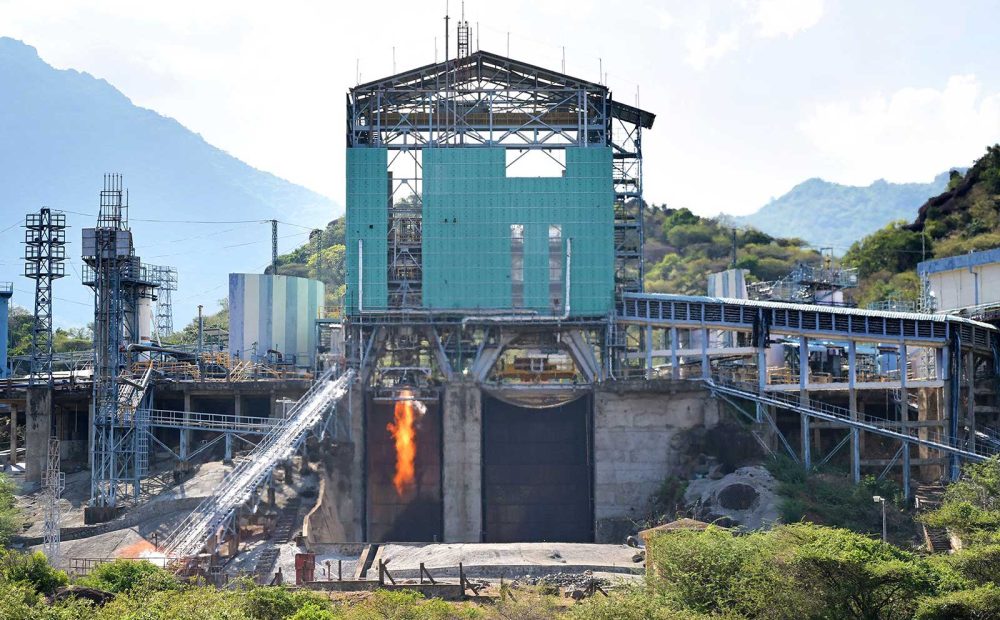
The Indian Space Research Organisation (ISRO) has successfully tested its indigenous CE20 cryogenic engine at an uprated thrust of 220 kN, marking a key step towards enhancing the payload capacity of India’s LVM3 rocket.
The flight acceptance hot test was conducted on September 9 at the ISRO Propulsion Complex in Mahendragiri, Tamil Nadu.
The CE20 engine, designed for the C32 cryogenic upper stage of an upcoming LVM3 mission, uses liquid oxygen and liquid hydrogen as propellants.
The higher 220 kN thrust is expected to enable LVM3, India’s heaviest operational launch vehicle, to carry heavier payloads. The upgraded C32 upper stage also holds more propellant than its earlier version, further improving the rocket’s performance.
The test also demonstrated the performance of the Liquid Oxygen Tank Pressurisation Module (LTPM), developed for the C32 stages that will be used in India’s Gaganyaan human-spaceflight missions.
Flight acceptance hot test of CE20 cryogenic engine earmarked for the C32 upper stage of upcoming LVM3 mission at uprated thrust conditions of 220kN is successfully carried out at ISRO Propulsion Complex, Mahendragiri on September 09, 2026.
Performance of the LOX Tank… pic.twitter.com/Jr1VvcbFsn
— ISRO (@isro) September 10, 2026
The system helps maintain the pressure required for the proper flow of liquid oxygen during flight.
The LVM3 has previously launched Chandrayaan missions and commercial satellites. Successful ground tests of the uprated engine and associated systems are aimed at reducing risks before operational missions, while supporting heavier satellite launches and bringing India closer to its first crewed Gaganyaan flights.