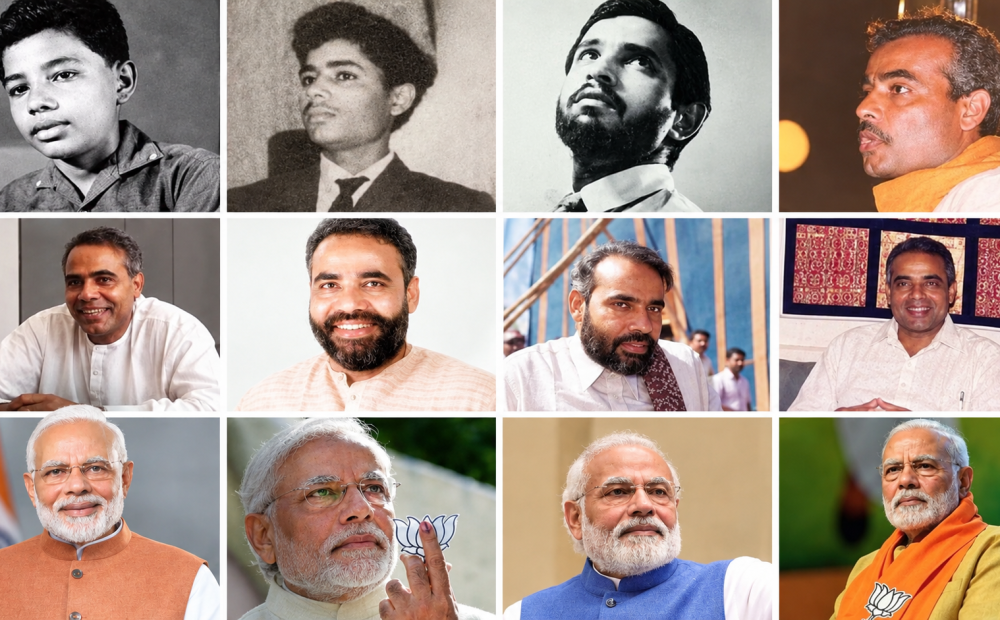
There are political journeys that begin with privilege, powerful family names or established connections. Narendra Damodardas Modi’s story began differently.
Born on Sept. 17, 1950, in Vadnagar, Gujarat, Modi grew up in a modest family and went on to build a political career that took him from the grassroots to the Prime Minister’s Office.

At 76, his journey spans decades of organisational work, political setbacks, controversies, electoral victories and national leadership.
From Vadnagar to the RSS
Modi’s early years were spent in Vadnagar, where he helped his family and, according to his own accounts, worked at the family tea stall. His association with the Rashtriya Swayamsevak Sangh (RSS) began at a young age. He eventually became a full-time pracharak, dedicating himself to organisational work.
Those early years were far removed from the political spotlight. Preparing food, travelling, meeting workers and handling routine organisational responsibilities became part of his political training.

The Emergency of 1975 became another defining experience. With the RSS banned and opposition activities restricted, Modi worked underground in Gujarat, according to accounts of the period, helping maintain networks and distribute anti-Emergency literature.
The BJP Years: Rise, Rivalries and Setbacks
After moving into the Bharatiya Janata Party (BJP), Modi established himself as an organiser rather than an electoral politician. By the 1990s, he had become an influential figure in Gujarat BJP politics.
But influence also brought internal conflicts.
During the political crisis involving Keshubhai Patel and Shankersinh Vaghela in 1995, Modi was moved out of Gujarat and given responsibilities at the national level.
For a politician who had built his career in Gujarat, it was a significant setback. However, the period also expanded his political network beyond the state and gave him valuable experience in national politics.

2001: The Return to Gujarat
In 2001, the BJP leadership chose Modi to replace Keshubhai Patel as Gujarat chief minister.
There was an immediate challenge: Modi had never contested an election.
He subsequently contested the Rajkot-II by-election and entered the Gujarat Assembly in February 2002.
His political career had now entered a new phase, moving from organisational politics to governance.

2002: The Crisis That Changed His Career
In February 2002, the Godhra train burning was followed by widespread communal violence across Gujarat. The episode became one of the most controversial chapters of Modi’s political life.

His government faced intense criticism over its handling of the violence, while Modi faced enormous political pressure, including calls for his resignation.
He offered to resign at a BJP national executive meeting, but the resignation was not accepted.
The issue continued to attract legal and political scrutiny for years. A Supreme Court-appointed Special Investigation Team later found insufficient evidence to prosecute Modi in connection with the larger conspiracy allegations. However, debates over the government’s handling of the violence continued.
From Gujarat to Delhi
Following the 2002 crisis, Modi increasingly built his political identity around development, investment and governance.
The Vibrant Gujarat summits and his emphasis on infrastructure and economic growth helped strengthen his image as a development-focused leader.
His repeated electoral victories in Gujarat eventually transformed him into a national contender.
In September 2013, the BJP named Modi as its prime ministerial candidate for the 2014 Lok Sabha election.

2014: The Biggest Political Transformation
The 2014 election changed Modi’s political career forever.
The BJP won 282 Lok Sabha seats on its own, securing a parliamentary majority. Modi was sworn in as India’s prime minister on May 26, 2014.

He returned to power in 2019 with an even larger BJP majority.
In 2024, he began his third term as prime minister after the BJP-led National Democratic Alliance (NDA) secured the numbers to form the government.

A Journey Still Being Written
From a small-town childhood in Vadnagar and years of RSS organisational work to the Gujarat chief minister’s office and eventually the Prime Minister’s Office, Narendra Modi’s journey has crossed more than seven decades of life and more than two decades at the heart of electoral politics.
Today, as he turns 76, his story is not simply about how far he has travelled, but also about the many turns the journey took along the way — including moments of struggle, political setbacks, controversy, responsibility and electoral success.

From a young pracharak working behind the scenes to a leader who went on to shape national politics, every chapter added a new dimension to his public life.
His journey, marked by organisational work, political upheavals and electoral milestones, continues to be written.