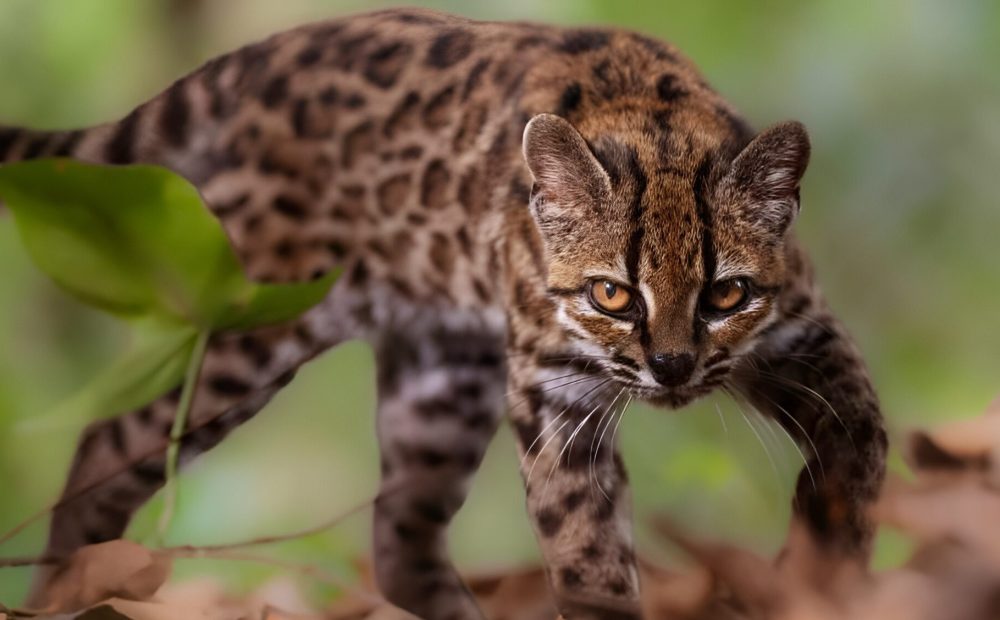
In a major evolutionary discovery, scientists have officially recognised a tiny, spotted wild cat inhabiting Bolivia’s cloud forests as a distinct feline species. Formally named Leopardus tilcayo, the animal represents the first new living felid species to be formally described and classified by science in over 100 years.
The species, commonly referred to as “Tilcayo” by indigenous communities, lives in the high-altitude, humid Yungas cloud forests of Bolivia. Findings detailed in the journal Current Biology reveal that the cat belongs to the tiger-cat lineage (Leopardus), but diverged from its closest relatives roughly 1.4 million years ago.
A Decade-Long Scientific Investigation
The journey toward formal identification began in 2016, when researchers encountered a captive individual at the Senda Verde Wildlife Sanctuary in Bolivia. Initially mistaken for a domestic kitten by a local resident who found it along a forest road, the animal’s distinct appearance—including a compact face, rounded ears, and unique rosette markings—prompted further investigation by National Geographic Explorer Paola Nogales-Ascarrunz.
Subsequent genetic analyses carried out alongside international researchers confirmed that the cat was distinct from Leopardus tigrinus and other known tiger-cat species across South America. Scientists noted that while tiger cats have historically been difficult to distinguish by visual appearance alone, genomic profiling provided conclusive proof of a separate evolutionary branch.
Physical Profile And Habitat
Measuring approximately 46 centimetres (18 inches) in length and weighing just 1.4 kilograms (3 pounds), Leopardus tilcayo is noticeably smaller than an average domestic cat. Its light-brown coat features irregular, dark rosettes that differentiate it visually from related species found in nearby regions like Brazil.
The animal remains largely elusive in the wild. Scat analysis indicates that its diet includes small forest rodents, while camera-trap footage suggests predominantly nocturnal activity patterns within the dense, mist-shrouded vegetation of the Yungas region.
Conservation Concerns And Future Outlook
While the species has long been known to local indigenous communities, researchers caution that very little remains understood about its broader population size or exact range. Scientists have submitted their findings to the International Union for Conservation of Nature (IUCN) to establish an official threat assessment.
With the fragile Yungas cloud forest ecosystem facing growing environmental pressures from habitat fragmentation and agricultural expansion, conservationists emphasise that swift action will be vital to safeguard the newly recognised feline.