New Delhi: India is hosting the 18th BRICS Summit in New Delhi on September 12-13, bringing together leaders of the expanded 11-member grouping at a time of growing geopolitical uncertainty, economic fragmentation and rapid technological change.
TOP UPDATES
Prime Minister Narendra Modi held a bilateral meeting with Abu Dhabi Crown Prince Sheikh Khaled bin Mohamed bin Zayed Al Nahyan at Hyderabad House in New Delhi on Saturday, with India and the United Arab Emirates seeking to deepen their Comprehensive Strategic Partnership.
The meeting took place on the sidelines of the 18th BRICS Summit, which India is hosting in the national capital on September 12-13.
PM Modi, Malaysian PM Anwar Ibrahim Hold Bilateral Meeting
PM Modi, Malaysian PM Anwar Ibrahim Hold Bilateral Meeting#BRICS2026 #BRICS #NarendraModi #AnwarIbrahim #Malaysia #India #NewDelhi #HyderabadHouse #IndiaMalaysia #BRICSSummit #Diplomacy #Trade #Investment #GlobalSouth #WorldNews pic.twitter.com/ty7f65EghS
— NewsMobile (@NewsMobileIndia) September 12, 2026
India-UAE Ties Take Centre Stage
The talks come as India and the UAE continue to expand cooperation in key areas, particularly trade, investment and energy security.
The Ministry of External Affairs had welcomed the Crown Prince’s participation in the BRICS Summit, saying his visit would provide an opportunity to further strengthen the India-UAE partnership.
“Warmly welcome Crown Prince of Abu Dhabi H.H. Sheikh Khaled bin Mohamed bin Zayed Al Nahyan to the 18th BRICS Summit in New Delhi,” the ministry said in a post on X.
The MEA said the partnership is centred on “robust trade and energy security for shared prosperity.”
BRICS Summit: Key Focus Areas
India is hosting the 18th BRICS Summit in New Delhi on September 12-13 under the theme “Building for Resilience, Innovation, Cooperation and Sustainability.”
Development, sustainability and innovation are among the key priorities of India’s BRICS Chairship.
The grouping has evolved into an important platform for coordination among major emerging economies, with its agenda spanning development, finance, technology, trade and people-to-people exchanges.
BRICS now comprises 11 full members — Brazil, China, Egypt, Ethiopia, India, Indonesia, Iran, Russia, Saudi Arabia, South Africa and the UAE.
The grouping also has 10 partner countries — Nigeria, Belarus, Bolivia, Cuba, Kazakhstan, Malaysia, Thailand, Uganda, Uzbekistan and Vietnam.
PM Modi holds bilateral meeting with Ethiopian counterpart Abiy Ahmed Ali on sidelines of BRICS Summit
India’s BRICS 2026 Agenda
India’s presidency comes at a time of growing global economic fragmentation, geopolitical uncertainty, technological disruption, climate pressures and concerns over resources.
New Delhi is seeking to turn the expanded membership of BRICS into greater practical cooperation in areas including development, climate action, technology, energy and financial resilience.
India’s broader objective is to build consensus among the diverse members while strengthening existing BRICS mechanisms and delivering tangible outcomes from its 2026 Chairship.
PM Modi Meets Abu Dhabi Crown Prince Sheikh Khaled In Delhi#BRICS2026 #BRICS #NarendraModi #SheikhKhaled #UAE #India #NewDelhi #IndiaUAE #AbuDhabi #BRICSSummit #Diplomacy #ForeignPolicy #GlobalSouth #InternationalRelations #WorldNews pic.twitter.com/k1nN4nRxdo
— NewsMobile (@NewsMobileIndia) September 12, 2026
The Modi-Khaled meeting, meanwhile, underlines the importance New Delhi attaches to its relationship with the UAE as both countries seek to expand economic cooperation and strengthen their role in a rapidly changing global order.
India’s BRICS Chairship is being guided by the theme “Building for Resilience, Innovation, Cooperation and Sustainability,” with development, sustainability and innovation at the centre of its agenda.
BRICS has emerged as a key platform for coordination among major emerging economies and for advancing the interests of the Global South in multilateral institutions. Its discussions span development, finance, technology, trade, energy and people-to-people exchanges.
The expanded grouping currently comprises Brazil, China, Egypt, Ethiopia, India, Indonesia, Iran, Russia, Saudi Arabia, South Africa and the United Arab Emirates.
Collectively, the 11 BRICS members account for around 49.5% of the global population, 40% of global GDP and 26% of global trade, according to background information on India’s 2026 Chairship.
India’s leadership comes against the backdrop of global economic fragmentation, geopolitical tensions, technological disruption, climate change and mounting pressure on critical resources.
The expanded BRICS platform provides member states with an avenue to deepen cooperation on development, climate action, technology, energy and financial resilience, while also pushing discussions on reforms to global institutions.
For New Delhi, the challenge is to turn the expanded representation of BRICS into meaningful cooperation and tangible outcomes while building consensus among countries with diverse economic and geopolitical interests.
BRICS leaders highlight innovation, resilient supply chains, trade growth and the need to turn economic potential into practical cooperation.
PM Modi Highlights BRICS’ Growing “Speed, Scale And Optimism”
Prime Minister Narendra Modi on Friday highlighted the growing economic strength of BRICS nations, calling them important centres of global innovation and solutions amid global uncertainties.
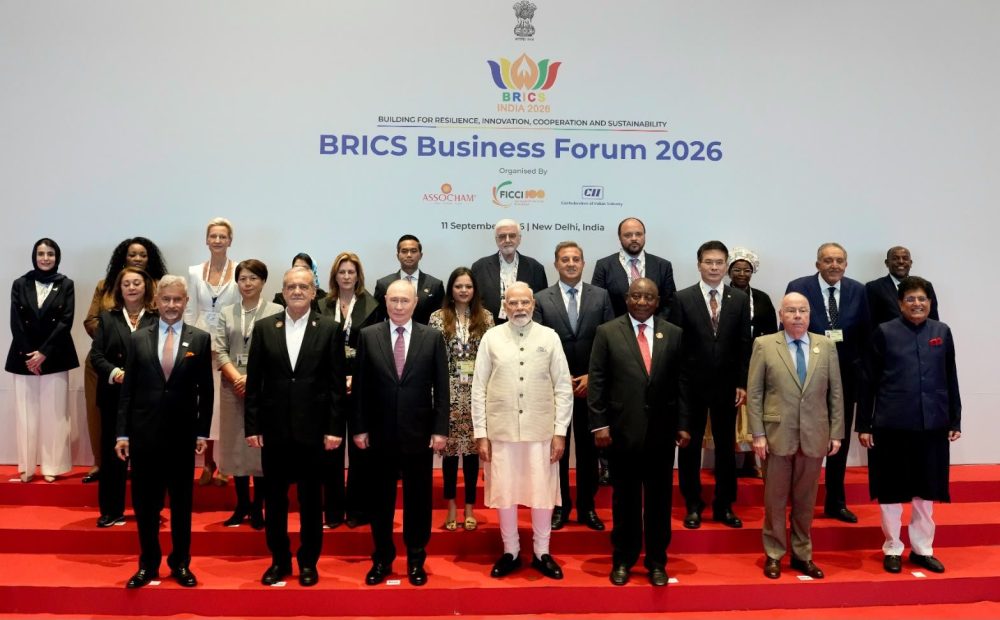
Speaking at the Leaders’ Session of the BRICS Business Forum, PM Modi said, “Today, BRICS nations represent 50% of the world’s population, 40% of its GDP, and over 25% of global trade. Moreover, while global GDP has grown approximately two-and-a-half-fold over these years, the combined GDP of BRICS nations has expanded nearly four-and-a-half-fold. In other words, the economic strength of BRICS has grown at nearly twice the pace of the rest of the world.”
He added, “BRICS nations are also emerging as key hubs for global innovation and solutions. New possibilities for innovation, spanning everything from grassroots initiatives to frontier technologies, are taking shape within our countries.”
The Prime Minister said India’s BRICS chairmanship is guided by the theme “Building for Resilience, Innovation, Cooperation, and Sustainability.”
“The theme of India’s BRICS chairmanship is ‘Building for Resilience, Innovation, Cooperation, and Sustainability.’ Over the past 12 years, India has made this mantra the foundation of its economic and trade policies,” the Prime Minister said.
He highlighted India’s expanding infrastructure and strategic capabilities, including shipbuilding, semiconductors, quantum technology, critical minerals and biotechnology, while noting that UPI now accounts for 50% of the world’s real-time payments.
“Today, while trade barriers are rising globally, India is building economic bridges. Since 2014, we have entered into free trade agreements with nearly 40 countries,” he said.
Putin Calls Business Ties Backbone Of Global Economy
Russian President Vladimir Putin said reliable business-to-business ties and economic partnerships are the backbone of international economic relations and can help overcome global challenges.
“This gathering shows the growing interest in strengthening business contacts and relations across the BRICS space. It is evident that reliable business-to-business ties and economic partnerships are the backbone of international economic relations. It helps build relations in a stronger, more resilient manner. It helps to overcome the problems the world is facing,” Putin said.
Putin also pointed to shifts in the global economic order, saying new engines of growth are replacing the traditional economic leaders.
“In the last five years, more than 40 per cent of the world’s GDP [is] contributed by BRICS, and the so-called G7, why they call it the great 7, stands only at 29 per cent,” the Russian President said.
Pezeshkian Seeks Shift From Potential To ‘Operational’ Cooperation
Iranian President Masoud Pezeshkian said BRICS’ strength goes beyond the size of its economies and depends on transforming their capacities into stronger trade, investment and joint financing networks.
“The world today is going through one of its most complex periods. Geopolitical uncertainty, disruption in its supply chains and the increasing use of economic instruments to exert political pressure have made economic environment in which countries operate more complex. The question is, what is BRICS response to these challenges?” he said.
“We believe that the true strength of BRICS is not confined merely to the size of its members’ economics rather it becomes more apparant when these capacities are transformed into a network of trade, investment and joint financing – a transition from potential cooperation to operational one,” he added.
The BRICS Business Forum was held a day before the formal opening of the BRICS Summit in New Delhi. The forum brought together business leaders, ministers and heads of state to discuss trade, investment, finance, technology and development challenges.
India is hosting the 18th BRICS Summit under its 2026 chairship, guided by the theme “Building for Resilience, Innovation, Cooperation and Sustainability.” The grouping currently comprises 11 countries — Brazil, China, Egypt, Ethiopia, India, Indonesia, Iran, Russia, Saudi Arabia, South Africa and the UAE.
India-Russia, India-Iran Talks In Focus
As world leaders arrive in New Delhi for the summit, key bilateral meetings are also drawing attention, with discussions between India and Russia and India and Iran expected to feature prominently.
The scale of the grouping underlines the economic weight of BRICS, with its members representing nearly half of the world’s population and a substantial share of global economic output and trade.
Among the key areas under discussion are smoother market access for micro, small and medium enterprises, efforts to develop uniform international trade standards and greater use of local currencies for cross-border transactions.
Such measures could help reduce dependence on traditional payment mechanisms and address external and current-account pressures for participating economies.
India and Russia are also looking to expand cooperation beyond traditional areas, with discussions covering defence joint production, aerospace, fertilisers and rare earth minerals that are increasingly important for industries such as semiconductors and electric vehicles.
Former diplomat Gurjit Singh has highlighted New Delhi’s convening power as leaders and key global partners gather for the summit and associated diplomatic engagements.
Iran President Pezeshkian Arrives In Delhi
Iranian President Masoud Pezeshkian has arrived in New Delhi to participate in the BRICS Summit.
The Ministry of External Affairs said Minister of State for Ports, Shipping and Waterways Shantanu Thakur received Pezeshkian at the airport.
“Pleased to welcome President of Iran, Dr Pezeshkian at the 18th BRICS Summit in New Delhi,” the MEA said in a post on X.
The ministry highlighted India and Iran’s longstanding civilizational ties and cultural and people-to-people connections, while noting their cooperation as BRICS partners.
Modi-Putin Meeting Ahead Of BRICS Summit
Russian President Vladimir Putin and Prime Minister Narendra Modi held bilateral talks in New Delhi on Friday, a day before the formal opening of the BRICS Summit.
The discussions are expected to include efforts to achieve an ambitious bilateral trade target, with India and Russia aiming to take bilateral trade to $100 billion by 2030.
Putin’s visit is expected to provide further momentum to the India-Russia strategic partnership.
Russia’s state-run TASS news agency reported that Putin is expected to present initiatives covering trade, economic and investment cooperation, as well as transport connectivity, during his participation in the BRICS Business Forum.
Xi Jinping To Meet Modi
Chinese President Xi Jinping is scheduled to arrive in New Delhi on Saturday for the BRICS Summit, marking his first visit to India in nearly seven years.
Xi is also expected to hold a bilateral meeting with Prime Minister Narendra Modi on the sidelines of the summit.
Beijing said the meeting would mark the third consecutive year in which the two leaders have met, following their encounters in Kazan and Tianjin.
Ahead of Xi’s visit, China on Friday said India and China should properly manage their differences and view bilateral relations from a strategic and long-term perspective.
The comments come as the two countries seek to stabilise ties while managing unresolved differences and expanding engagement in areas of mutual interest.
Egyptian President Arrives In India Ahead Of BRICS Summit
Egyptian President Abdel Fattah El-Sisi arrived in the national capital on Friday to attend the 18th BRICS Summit, with India set to host the grouping’s leaders’ summit on September 12 and September 13 under its 2026 chairship.
El-Sisi was received at the airport by Minister of State for Defence Sanjay Seth. The arrival of the Egyptian President comes as several key leaders and dignitaries reach the national capital for the summit.
With leaders from the expanded BRICS grouping converging on New Delhi, the summit is set to test India’s ability to bridge differing interests while positioning the grouping as a stronger voice for the Global South in a rapidly changing global order.