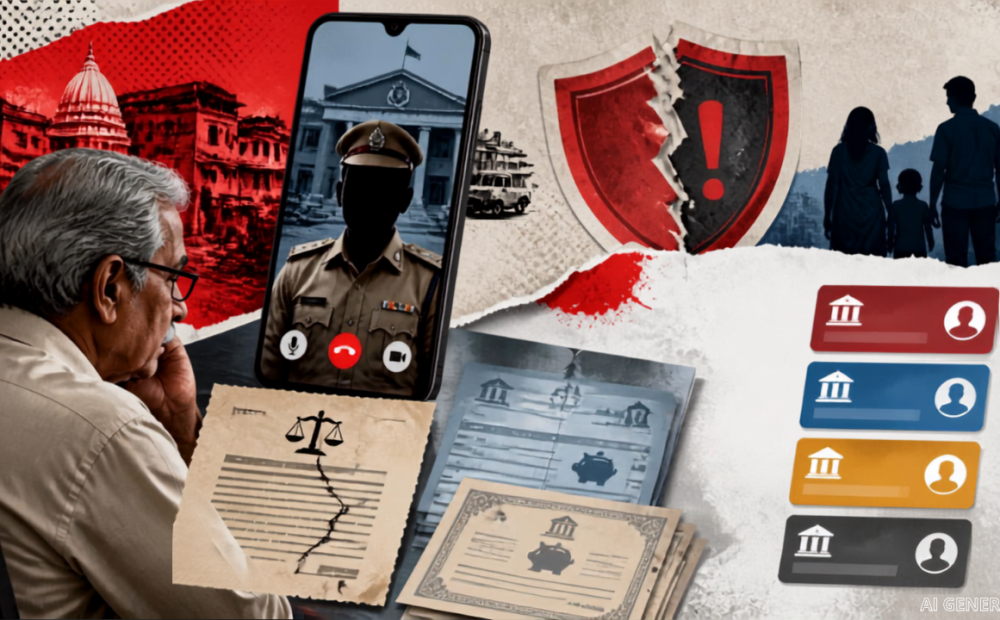
A 69-year-old man from Pune’s Budhwar Peth allegedly lost Rs 29.15 lakh after cybercriminals posing as police officials threatened to arrest him in a fake money laundering case.
According to a complaint filed with Vishrambaug police, the fraud took place between August 14 and 28.
The suspects allegedly contacted the man through a video call while posing as officials from Nashik police. They appeared in police uniforms and used what appeared to be a police station backdrop to make the call look genuine.
The fraudsters told the man that his bank account had received money linked to a money laundering case, making him a suspect. They also allegedly accused him of being connected to an illegal online business.
The scammers then demanded details of his bank accounts. According to police, the victim shared information about his accounts as well as his fixed deposits.
The threats escalated when the suspects allegedly warned that he would be arrested and that the case could bring disgrace to him and his family.
They then offered to “help” him settle the matter and provided details of four bank accounts into which he was asked to transfer money. The man eventually transferred Rs 29.15 lakh, police said.
The incident is another example of how scammers use fake identities, video calls, threats of arrest and fabricated criminal cases to pressure victims into transferring money.
Reader’s Note: What To Do If You Receive A Digital Arrest Call
No genuine police officer or investigating agency can conduct an arrest through a video call or demand money to “settle” a criminal case.
If someone threatens you with arrest over a phone or video call:
• Stay calm and disconnect the call.
• Do not share your Aadhaar, PAN, bank details, OTPs or passwords.
• Do not transfer money to any account given by the caller.
• Verify the claim independently by contacting the concerned police station or agency through its official contact details.
• Inform a family member or someone you trust immediately.
• Report financial cyber fraud as soon as possible through the national cybercrime helpline 1930 or the official cybercrime reporting portal.
Remember: A uniform, police-station background or video call does not prove that the person on the other side is a genuine officer.