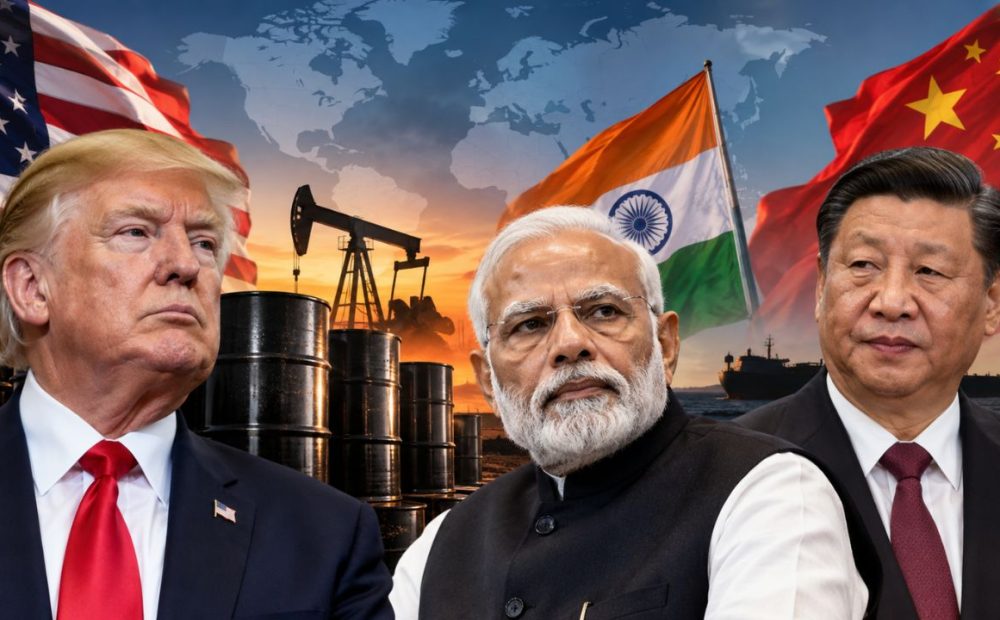
Washington, DC: The next few days could prove critical for India as the United States weighs the possibility of imposing additional tariffs on countries importing Russian oil. While the White House will ultimately decide how to proceed, the larger geopolitical picture suggests that New Delhi’s fate could be closely linked to Washington’s evolving engagement with Beijing.
US President Donald Trump has the authority under legislation passed by Congress to impose tariffs of up to 100% on countries purchasing Russian oil and gas. India and China, two of the largest buyers of Russian crude, could be affected by any decision to exercise that authority. However, the legislation does not automatically impose such tariffs.
The upcoming meeting between Trump and Chinese President Xi Jinping in Washington on Sept. 24 could play an important role in determining how the situation develops. The two leaders are expected to discuss several issues, including trade, artificial intelligence, critical minerals and broader strategic concerns.
The messaging emerging from Washington suggests that the Trump administration wants Xi’s visit to serve as a foundation for further engagement between the two countries. The proposed discussions could provide an opportunity for the United States and China to address areas of cooperation while negotiating their differences.
This broader diplomatic engagement is important for India because China is also a major importer of Russian oil. Any decision by the United States to impose tariffs on countries purchasing Russian energy could have implications for both Beijing and New Delhi.
India’s Energy Security Remains Central
India has made it clear that its energy security remains a priority. In its recent response to the US sanctions legislation, the Ministry of External Affairs reiterated that India would take necessary steps to protect its trade and economic interests while ensuring energy security for its 1.4 billion people.
New Delhi has also indicated that it will continue to diversify its energy sources based on evolving market conditions. At the same time, India remains mindful of the importance of its strategic partnership with the United States.
There is a diplomatic balancing act underway. India recognises the importance of its relationship with Washington, but there are also issues on which the two countries may not agree.
If additional tariffs are imposed, India will have to explore other options to protect its economic interests and maintain access to energy supplies.
However, it is important not to jump to conclusions about what might happen next. The diplomatic channels between India and the United States remain open, and negotiations are likely to play a significant role in determining the outcome.
Tariffs Could Become a Bargaining Chip
The US legislation gives the president considerable flexibility in deciding how and when to apply the proposed measures. It also allows for exemptions when the administration determines that doing so is in the national interest.
This provides Washington with room to negotiate. Tariffs and sanctions need not be viewed solely as punitive instruments; they can also become bargaining tools in broader diplomatic and economic discussions.
The key questions now are whether India could secure an exemption and whether China might receive similar consideration. Those decisions will depend on the negotiations taking place between the respective governments.
From India’s standpoint, the situation will require careful diplomacy. New Delhi will need to protect its energy interests while managing its relationship with Washington and monitoring developments involving Beijing.
A Crucial Phase for Global Diplomacy
The coming days could witness intense diplomatic activity involving New Delhi, Washington and Beijing.
Trump’s engagement with Xi, the US administration’s approach to Russian oil buyers and India’s ongoing discussions with Washington could all influence the direction of the tariff debate.
A diplomatic solution remains possible. But much will depend on how the negotiations unfold and how the White House chooses to use the authority granted to it by Congress.
For now, the situation calls for patience rather than speculation. The next phase of diplomacy between India, the United States and China will be crucial in determining what comes next.