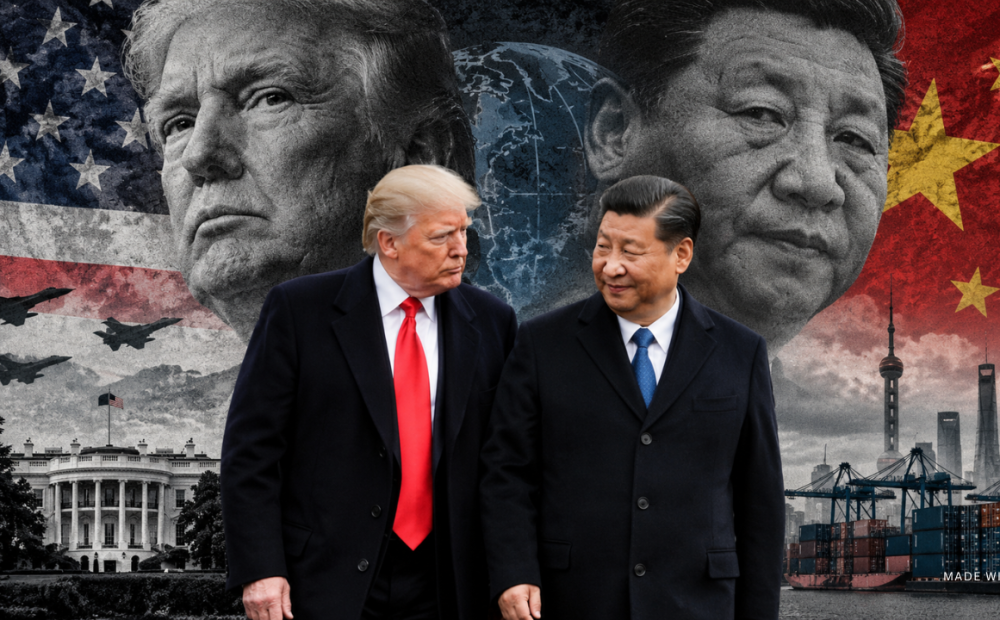
Washington, DC: The meeting between US President Donald Trump and Chinese President Xi Jinping was cordial in public, but the real significance of the summit lies in what happened behind the carefully choreographed optics.
The Trump-Xi summit was not simply about trade, tariffs or the photographs of the two leaders standing together at the White House. It was about defining a new framework for managing the increasingly complex relationship between the world’s two most powerful countries.
Sources familiar with the discussions tell me that several difficult issues were raised behind closed doors, including Iran, Taiwan, artificial intelligence, military-to-military communication and market access.
Iran and Taiwan remain key sticking points
One of the issues raised by the US side was China’s relationship with Iran. Washington expressed concerns over alleged Chinese assistance to the Islamic Revolutionary Guard Corps, including the provision of intelligence and coordinates.
The Iran issue is particularly significant because Washington and Beijing have publicly agreed on one point: Iran must not be allowed to acquire a nuclear weapon.
The White House said after the summit that Trump and Xi discussed Iran and agreed that Iran can never have a nuclear weapon. The two sides also agreed to work toward strategic stability and continued dialogue.
The real test, however, will be whether Beijing translates these assurances into action.
Xi, meanwhile, raised Taiwan and reiterated China’s concerns about what Beijing considers its core interests. The Chinese position remains that Washington should ensure strategic stability and avoid actions that undermine China’s interests.
Taiwan remains one of the most sensitive issues in the U.S.-China relationship, and it is unlikely to disappear simply because the two leaders have established a more cordial channel of communication.
AI could become a new area of cooperation
There was, however, a meeting of minds on artificial intelligence — or what President Trump has now referred to as “super intelligence.”
Both sides appear to recognize that AI represents the next major frontier of technological and economic competition. At the same time, there is an emerging understanding that the risks associated with increasingly powerful AI systems cannot be managed by either country in isolation.
The White House said the two countries agreed to establish a US-China Super Intelligence Dialogue to discuss the risks and benefits of the technology. They also agreed to establish a bilateral communication channel for AI-related incidents, with another exchange planned by November.
This could prove to be one of the most consequential outcomes of the summit.
The competition between Washington and Beijing over AI will continue, but dialogue between the two sides could help prevent technological competition from turning into an uncontrolled strategic confrontation.
Trade delivers political and economic gains
Trade remained central to the discussions.
The two countries agreed on measures involving tariff treatment for $30 billion of non-sensitive goods in each direction, while also creating mechanisms to address market-access barriers. China also committed to importing at least 10 million metric tons of US coal in both 2027 and 2028.
For Trump, agricultural purchases are particularly important. American farmers stand to benefit from greater access to the Chinese market, and that gives the president a tangible economic achievement to highlight domestically.
The White House has also emphasized China’s commitments on agricultural products, critical minerals and other areas of trade.
But this is not a one-sided arrangement.
China wants greater and fairer access for its companies to the U.S. market, while Washington wants greater access to Chinese markets and more reliable supplies of critical minerals.
That makes market access one of the most important areas to watch after the summit.
Critical minerals and market access
The presence of leading U.S. technology executives at the state dinner was also significant.
Technology companies are deeply dependent on supply chains involving China, while China remains heavily invested in areas where the United States possesses technological and financial advantages.
The US has been particularly concerned about China’s control over rare earths and other critical minerals. The White House said the two sides would continue working on supply-chain shortages involving rare earths and critical minerals, with the objective of restoring shipments to appropriate levels.
The message from Washington was therefore clear: economic engagement cannot be separated from national security.
Military confidence-building measures
Another important element was the discussion on military-to-military confidence-building measures.
With US and Chinese forces operating in close proximity across the Indo-Pacific, the possibility of an accident or miscalculation remains a serious concern.
The Chinese side has pushed for greater communication and confidence-building mechanisms between the two militaries. Such mechanisms can become particularly important during periods of heightened tensions over Taiwan, the South China Sea or other regional flashpoints.
The objective is not necessarily to eliminate strategic competition. It is to ensure that competition does not inadvertently escalate into conflict.
The message behind the spectacle
Beyond the substance of the talks, President Trump was also sending a message through the staging of the visit.
The state arrival ceremony featured a military review and a flyover involving a B-2 Spirit and four F-22 Raptors.
That was not merely ceremonial.
Trump wanted to demonstrate that while Washington is prepared to engage Beijing, the United States continues to view itself as the preeminent military and geopolitical power.
The symbolism was carefully orchestrated: diplomacy on one side, military strength on the other.
The state dinner, meanwhile, brought together senior business and technology leaders, reinforcing another message — that the relationship with China is not merely a diplomatic issue. It is also an economic and technological one.
From rivalry to managed competition?
What emerged from the summit, in my view, is the beginning of a new template for global geopolitics.
For years, the US-China relationship has largely been defined by competition — trade wars, technology restrictions, military tensions and disagreements over Taiwan.
The summit suggests that both sides now recognize the need to manage that competition through structured dialogue.
It could eventually evolve into something resembling a G2 framework, in which Washington and Beijing not only discuss bilateral disputes but also coordinate, or at least communicate closely, on major global issues.
That does not mean the two countries have become allies. They remain strategic competitors with fundamentally different political systems, interests and ambitions.
But there is an emerging recognition that neither Washington nor Beijing can ignore the other when dealing with global crises.
The real test begins now
The summit produced important commitments, but the real test will be implementation.
Will China follow through on its assurances regarding Iran? Will the two sides maintain their dialogue on AI? Will the military confidence-building mechanisms actually reduce the possibility of miscalculation? Will market-access commitments translate into meaningful opportunities for businesses? And will the arrangements on critical minerals survive the next round of geopolitical tensions?
These are the questions that will determine whether the summit was merely an exercise in diplomatic optics or the beginning of a more durable framework.
For now, the Trump-Xi summit has created a channel for dialogue at a time when the world is entering an increasingly turbulent phase.
The importance of the meeting, therefore, lies not just in what Trump and Xi agreed to, but in the fact that the two leaders appear willing to establish mechanisms to manage their disagreements.
The world will now watch what happens next.
The summit may have produced the optics of friendship and cooperation. Its real significance will be measured by what Washington and Beijing do when the cameras are gone.