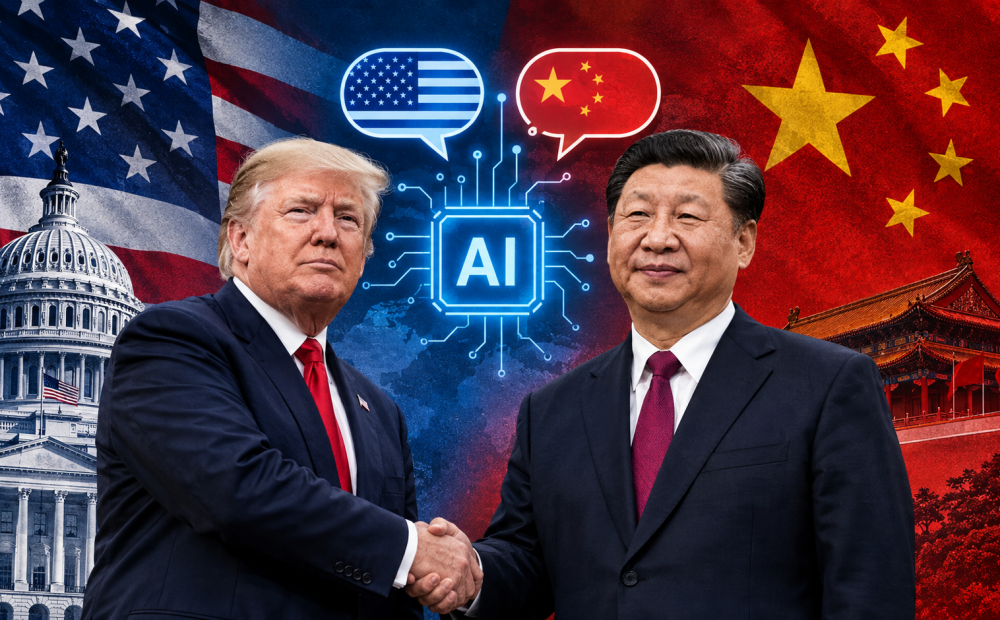
Washington, DC: The United States and China have agreed to establish a new dialogue on artificial intelligence and a communication channel for AI-related incidents, putting emerging technology at the center of agreements reached during Chinese President Xi Jinping’s Sept. 23-25 state visit to the United States.

In my analysis of the Trump-Xi summit, the “SuperIntelligence” dialogue, strategic stability and the effort to keep the bilateral engagement on track emerge as among the meeting’s biggest takeaways. The summit reflects a “compete and collaborate” approach, with both leaders securing strategic optics while creating space for continued engagement. The visit also prominently showcased U.S. military capabilities amid considerable diplomatic ceremony and symbolism.
The White House said President Donald Trump and Xi agreed to use the term “super intelligence” for applicable emerging technologies and established a U.S.-China Super Intelligence Dialogue to discuss its risks and benefits.
The next exchange is expected by November 2026. China’s Foreign Ministry also said the two sides would continue discussions on AI, exchange views on its risks and benefits, and establish communication channels for AI-related issues.

The leaders also agreed to build what both sides described as a constructive strategic relationship based on respect, fairness and reciprocity.
They agreed to support each other’s hosting of the 2026 APEC meeting and G20 Summit and said they intend to attend events hosted by the other country.

Trade was another major element of the discussions. The two governments reached a framework for more favorable tariff treatment covering $30 billion of nonsensitive goods in each direction and advanced their respective Boards of Trade and Investment.
The trade discussions cover agricultural products, seafood, wood products, cosmetics and medical devices, as well as consumer goods such as appliances, toys and children’s car seats. China is also set to import at least 10 million metric tons of U.S. coal in both 2027 and 2028.
On counternarcotics, Washington highlighted China’s new controls on two fentanyl precursor chemicals and the August arrest of 21 Chinese citizens linked, according to U.S. information, to precursor-chemical production and distribution.
China said the two countries’ drug-enforcement agencies had cooperated on cases involving new psychoactive substances and precursor chemicals.
The leaders also discussed Iran, Russia, North Korea and international waterways, while recalling that the United States and China fought as allies during World War II.

The White House said the two sides are continuing discussions on critical-mineral supply chains and trilateral arms-control talks involving Russia.
The visit also included the arrival of two giant pandas loaned by China to the Atlanta Zoo.
US President Donald Trump described his meeting with Chinese President Xi Jinping as a “tremendous” visit, saying the two sides had made “great strides” and that the outcome was “very positive for both countries.”#DonaldTrump #XiJinping #USChina #USChinaRelations #Diplomacy pic.twitter.com/tZYa8Tha28
— NewsMobile (@NewsMobileIndia) September 25, 2026
President Trump Bids Farewell to Xi Jinping as Chinese President Concludes Three-Day U.S. State Visit#Trump #XiJinping #USChina #StateVisit #WhiteHouse #China #UnitedStates pic.twitter.com/JzEBqFr5Br
— NewsMobile (@NewsMobileIndia) September 25, 2026
With inputs from-
Apoorva Raj, Senior Correspondent