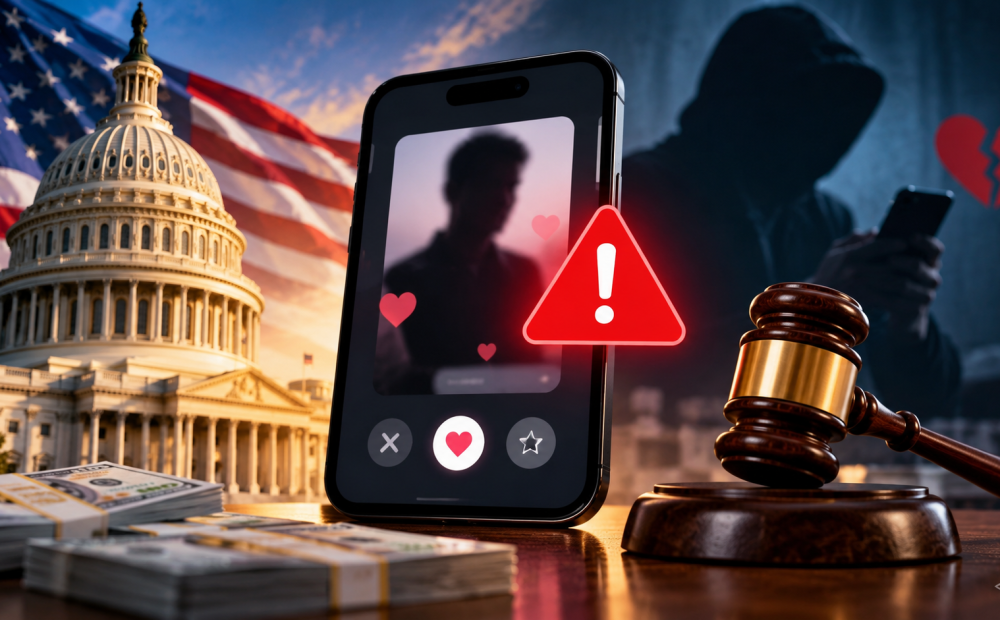
Washington, DC: A new US law will require online dating platforms to alert users when someone they have interacted with is banned for fraud, introducing additional safeguards as romance scams continue to cause significant financial losses.
Signed by President Donald Trump on October 20, the bipartisan Romance Scam Prevention Act was unanimously passed by the Senate in late September. The legislation was backed by Senators Marsha Blackburn of Tennessee and John Hickenlooper of Colorado, while Representative David Valadao of California introduced the bill in the House.
According to Federal Trade Commission data cited by the International Consortium of Investigative Journalists (ICIJ), Americans reported more than 70,000 romance scams in 2025, resulting in losses of $1.47 billion.
Under the law, dating services must notify users who exchanged messages with an account subsequently banned for fraud. The notification must generally be sent within 24 hours of the ban and identify the account, specify the most recent interaction and warn users about potential deception.
Platforms must also advise recipients against sending money or financial information and provide fraud-prevention resources and customer support details. The law will take effect in one year and will be enforced by the Federal Trade Commission and state attorneys general.
The legislation follows growing scrutiny of dating platforms over their efforts to identify fraudulent accounts. A recent report by the minority staff of the Joint Economic Committee found that the median number of profile views received by a scammer on Match Group platforms before being banned increased from fewer than 70 in May 2024 to more than 500 in December 2025.
The law also addresses a key vulnerability: victims may continue communicating with suspected scammers outside dating apps even after their accounts are removed.
Valadao said the legislation aims to strengthen online safety and protect Americans from financial fraud. Its implementation is expected to give users an additional warning when a potentially fraudulent contact is identified and banned.