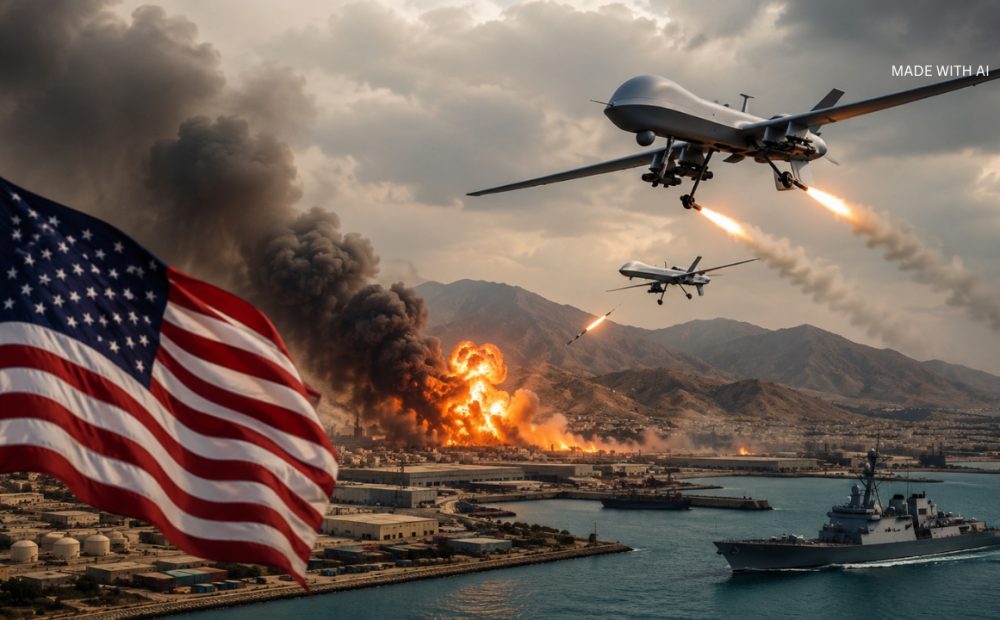
The United States on Sunday struck two Iranian rocket launch systems on Larak Island in the Strait of Hormuz after US forces detected Islamic Revolutionary Guard Corps personnel preparing to launch rockets carrying sea mines into the strategically vital waterway, according to a US official cited by Reuters.
The strikes mark the first known US attack on Iranian territory since late July and represent a fresh escalation in the conflict, which has now entered its seventh month.
“I can confirm that earlier today US forces struck two Iranian launchers on Larak Island,” the US official told Reuters, adding that IRGC forces had been observed preparing to launch rockets with sea mines into the Strait of Hormuz.
US Central Command spokesperson Tim Hawkins also said Iranian forces had been observed preparing for a launch. Washington has maintained that its military action is aimed at ensuring the continued flow of commercial shipping through the waterway.
Larak Island is located south of Hormuz Island and east of Qeshm Island, off Iran’s southern coast. The island covers roughly 49 square kilometers and occupies a strategically important position close to the Strait of Hormuz, one of the world’s most critical maritime chokepoints.
Iran Vows Response
Iran’s Islamic Revolutionary Guard Corps confirmed that Larak Island had come under attack and said several military personnel and civilians were killed or wounded.
Iranian state media quoted the IRGC as warning that the attack would receive a “response and punishment.”
IRGC spokesperson Gen. Hossein Mohebi described the strike as a serious mistake by the Trump administration and warned that the United States would face consequences on both military and economic fronts.
Iranian state broadcaster IRIB reported casualties among Iranian personnel and civilians, while Tasnim News Agency, affiliated with the IRGC, reported that a drone strike killed two people and wounded two others.
The reports could not be independently verified.
The strike came after US President Donald Trump warned that Washington would take decisive action against any attempt by Iran to lay new mines in the Strait of Hormuz.
Trump had earlier said on Truth Social that any ship or boat involved in placing new mines in the waterway would be destroyed, declaring a “Zero Tolerance” policy toward mine placement.
Strait Of Hormuz At The Centre Of Conflict
The latest US operation comes as the Strait of Hormuz remains a major flashpoint in the wider conflict.
Roughly one-fifth of global oil and liquefied natural gas shipments normally pass through the waterway, making any disruption a major concern for international energy markets and global trade.
US forces said last week that they had completed an operation to clear sea mines from international shipping routes in the strait. Washington has also said that it redirected 83 commercial vessels and disabled three vessels as part of its blockade of Iranian ports.
Despite US assertions that the strait remains open, commercial traffic has fallen sharply.
Trump has said 24 vessels passed through the waterway last week, a fraction of the roughly 130 vessels that crossed it each day before the conflict.
A multinational coalition overseen by the US Navy has said commercial traffic continues at reduced levels.
On Saturday, the United Kingdom Maritime Trade Operations agency reported that an unknown projectile struck a tanker north of Khasab, Oman. No casualties or environmental damage were reported.
Conflict Enters New Phase
The United States and Israel launched their joint military campaign against Iran on Feb. 28, triggering Iranian missile and drone attacks against Israel and Gulf states hosting US military installations.
The latest strike comes only days after the Trump administration signalled a greater emphasis on economic pressure rather than sustained military operations.
Washington has announced additional sanctions targeting Iran and warned that countries and entities continuing to conduct business with Tehran could face secondary sanctions.
The shift comes as the prolonged conflict puts pressure on US military resources and munitions stockpiles, raising concerns about the impact of an extended campaign on American military readiness elsewhere.
Trump has maintained that he is not in a rush to bring Iran back to the negotiating table while insisting that Tehran’s leadership is under severe pressure.
Iran, meanwhile, has continued to use its military capabilities around the Strait of Hormuz as leverage. Tehran retains missiles and drones capable of threatening vessels transiting the waterway and has continued to reject restrictions imposed by Washington.
Iran has also said that an arrangement reached with Oman to manage the strait cannot be implemented until the United States meets its obligations under a memorandum of understanding signed in June.
Mojtaba Khamenei Calls For Muslim Unity
The latest US strike came hours after Iran’s Supreme Leader Mojtaba Khamenei called on Muslim-majority countries across the region to unite against the United States and Israel.
Khamenei issued the written message to mark the birthday of Prophet Mohammed, six months after the beginning of the war.
He called for greater cooperation among Muslim nations and warned against actions that could deepen divisions within the Muslim community.
“Recognise your real enemy, understand its plan, and confront it,” Khamenei said.
His appeal came as tensions continued to rise across the region and the Strait of Hormuz remained at the centre of the confrontation between Washington and Tehran.
Why Larak Island Matters?
Larak Island’s strategic value comes from its location near the Strait of Hormuz, the narrow maritime passage connecting the Persian Gulf with the Gulf of Oman.
Situated off the coast of Bandar Abbas and close to major shipping routes, the island has long held military significance for Iran. It hosts an IRGC Navy facility and has historically been associated with missile positions and other military installations.
Its proximity to the strait gives Iranian forces the ability to monitor and potentially influence maritime activity through one of the world’s most important energy corridors.
Sunday’s US strike therefore carries significance beyond the destruction of two launch systems. It underscores Washington’s willingness to target Iranian military assets on Iranian territory if it believes Tehran is preparing to threaten shipping through the Strait of Hormuz.
With Iran vowing retaliation and commercial traffic through the strait still severely reduced, the latest exchange risks opening another dangerous phase in the already prolonged conflict.